
6 min read | 10 Feb 2026

How to calculate late payment fees in the UK (with calculator)

Stylized halftone image of a mountain peak with a beige sky
  • Published

  • 10 Feb 2026

  • Author

  • Anna Turner-Major

How to use late payment fees to nudge customers to make payment - all in line with the Late Payment of Commercial Debts (Interest) Act 1998.

divider

What are late payment fees in the UK?

If you are a business in the UK selling to other businesses, you are allowed to charge late payment fees from the moment an invoice becomes overdue.


The late payment fee is made up of two things:

Late payment fee = (1) Statutory interest + (2) Compensation fee


Imposing a fee on a customer the moment they become overdue might sound aggressive and (honestly) not many businesses do that. However, giving yourself the option to apply one is a helpful tool to nudge customers to pay.

How do I calculate a late payment fee?

Statutory interest

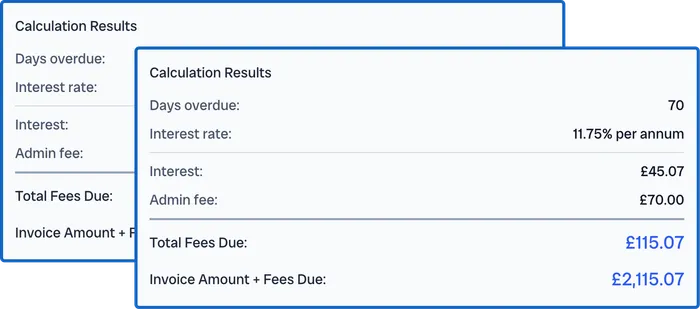
Statutory interest is set at the following rate: 8% + Bank of England base rate


Unless you have a different rate in your payment terms, you can charge this rate to all business customers. The interest increases daily which acts as a good incentive to customers who are slow to pay.


Compensation fee

The compensation fee is there to compensate you for the extra trouble of recovering an overdue invoice. The amount you can charge depends on how much the overdue invoice is worth:

  • £0-£999: £40
  • £1,000-£9,999: £70
  • £10,000+: £100


These amounts are set by late payment legislation.


When an invoice is one day overdue, even a large invoice won't have accrued much interest. However, the compensation fee can be charged immediately which makes it a good tool to nudge customers to pay.

Do I need to include late payment fees in my contract?

Statutory late payment fees for businesses apply either way, but adding them to your terms is best practice and helps you push back if a customer disputes the charge.


Here's a sample paragraph:

If any invoice is not paid by the due date, we reserve the right to charge interest on the overdue amount at the statutory rate of 8% per annum above the Bank of England base rate, in accordance with the Late Payment of Commercial Debts (Interest) Act 1998. We may also charge a fixed compensation fee for debt recovery costs as set out in the Act. Interest will accrue daily from the date payment becomes overdue until the date of actual payment.

Late payment fee email template

Most companies using Trove never get around to applying a late fee. Just mentioning that they will have to start applying one is enough to nudge most customers into paying - or at the very least replying. Here's an example email you can use with a customer:


----


Subject: Outstanding Invoice INV-1234 - Action Required

Date: 9 February 2026


Hi Mary,


I'm writing regarding invoice INV-1234 for £280 which was due on 1 January.


We've reached out several times (5 Jan, 12 Jan, 19 Jan, and 26 Jan) but haven't yet received payment or heard back about any issues with the invoice.


As per our payment terms and in line with UK late payment legislation, we are now applying the following statutory charges:

  • Late payment interest: £3.52
  • Debt recovery compensation fee: £40.00
  • Total late fees: £43.52


This brings the outstanding balance to £323.52.


However, we would much prefer to resolve this without additional charges. If you can settle the original invoice amount of £280 by 16 February we will waive the late fees entirely.


Please let me know if there are any issues preventing payment.


Kind regards, 

Anna


---


This will nudge the customer while still confirming that you are on their side and care more about the relationship than adding late fees.

Automate late payment fees with Trove

If all of this sounds like a lot of work, you are correct. Trove automates all of this work so you know the right late fees are applied at the right time. Book your demo now.

Divider

Recent articles

Trove

Collect your treasure

© Trove Data Ltd, Company Number 16234512 registered in England & Wales, 2025

6 min read | 10 Feb 2026

How to calculate late payment fees in the UK (with calculator)

Stylized halftone image of a mountain peak with a beige sky
  • Published

  • 10 Feb 2026

  • Author

  • Anna Turner-Major

How to use late payment fees to nudge customers to make payment - all in line with the Late Payment of Commercial Debts (Interest) Act 1998.

Divider

What are late payment fees in the UK?

If you are a business in the UK selling to other businesses, you are allowed to charge late payment fees from the moment an invoice becomes overdue.


The late payment fee is made up of two things:

Late payment fee = (1) Statutory interest + (2) Compensation fee


Imposing a fee on a customer the moment they become overdue might sound aggressive and (honestly) not many businesses do that. However, giving yourself the option to apply one is a helpful tool to nudge customers to pay.

How do I calculate a late payment fee?

Statutory interest

Statutory interest is set at the following rate: 8% + Bank of England base rate


Unless you have a different rate in your payment terms, you can charge this rate to all business customers. The interest increases daily which acts as a good incentive to customers who are slow to pay.


Compensation fee

The compensation fee is there to compensate you for the extra trouble of recovering an overdue invoice. The amount you can charge depends on how much the overdue invoice is worth:

  • £0-£999: £40
  • £1,000-£9,999: £70
  • £10,000+: £100


These amounts are set by late payment legislation.


When an invoice is one day overdue, even a large invoice won't have accrued much interest. However, the compensation fee can be charged immediately which makes it a good tool to nudge customers to pay.

Do I need to include late payment fees in my contract?

Statutory late payment fees for businesses apply either way, but adding them to your terms is best practice and helps you push back if a customer disputes the charge.


Here's a sample paragraph:

If any invoice is not paid by the due date, we reserve the right to charge interest on the overdue amount at the statutory rate of 8% per annum above the Bank of England base rate, in accordance with the Late Payment of Commercial Debts (Interest) Act 1998. We may also charge a fixed compensation fee for debt recovery costs as set out in the Act. Interest will accrue daily from the date payment becomes overdue until the date of actual payment.

Late payment fee email template

Most companies using Trove never get around to applying a late fee. Just mentioning that they will have to start applying one is enough to nudge most customers into paying - or at the very least replying. Here's an example email you can use with a customer:


----


Subject: Outstanding Invoice INV-1234 - Action Required

Date: 9 February 2026


Hi Mary,


I'm writing regarding invoice INV-1234 for £280 which was due on 1 January.


We've reached out several times (5 Jan, 12 Jan, 19 Jan, and 26 Jan) but haven't yet received payment or heard back about any issues with the invoice.


As per our payment terms and in line with UK late payment legislation, we are now applying the following statutory charges:

  • Late payment interest: £3.52
  • Debt recovery compensation fee: £40.00
  • Total late fees: £43.52


This brings the outstanding balance to £323.52.


However, we would much prefer to resolve this without additional charges. If you can settle the original invoice amount of £280 by 16 February we will waive the late fees entirely.


Please let me know if there are any issues preventing payment.


Kind regards, 

Anna


---


This will nudge the customer while still confirming that you are on their side and care more about the relationship than adding late fees.

Automate late payment fees with Trove

If all of this sounds like a lot of work, you are correct. Trove automates all of this work so you know the right late fees are applied at the right time. Book your demo now.

Divider

Overdue invoice?

Take the right action every time with Trove.

credit card icon

Propose payment plan

sparkles icon

Draft reply

dollar icon

Apply late payment fee

calendar icon

Schedule monthly statement

... and more

arrow

Book a demo

Divider

Recent articles

Trove

Collect your treasure

© Trove Data Ltd, Company Number 16234512 registered in England & Wales, 2025

6 min read | 10 Feb 2026

How to calculate late payment fees in the UK (with calculator)

Stylized halftone image of a mountain peak with a beige sky
  • Published

  • 10 Feb 2026

Author Image
  • Author

  • Anna Turner-Major, CEO & Co-founder

How to use late payment fees to nudge customers to make payment - all in line with the Late Payment of Commercial Debts (Interest) Act 1998.

Divider

What are late payment fees in the UK?

If you are a business in the UK selling to other businesses, you are allowed to charge late payment fees from the moment an invoice becomes overdue.


The late payment fee is made up of two things:

Late payment fee = (1) Statutory interest + (2) Compensation fee


Imposing a fee on a customer the moment they become overdue might sound aggressive and (honestly) not many businesses do that. However, giving yourself the option to apply one is a helpful tool to nudge customers to pay.

How do I calculate a late payment fee?

Statutory interest

Statutory interest is set at the following rate: 8% + Bank of England base rate


Unless you have a different rate in your payment terms, you can charge this rate to all business customers. The interest increases daily which acts as a good incentive to customers who are slow to pay.


Compensation fee

The compensation fee is there to compensate you for the extra trouble of recovering an overdue invoice. The amount you can charge depends on how much the overdue invoice is worth:

  • £0-£999: £40
  • £1,000-£9,999: £70
  • £10,000+: £100


These amounts are set by late payment legislation.


When an invoice is one day overdue, even a large invoice won't have accrued much interest. However, the compensation fee can be charged immediately which makes it a good tool to nudge customers to pay.

Do I need to include late payment fees in my contract?

Statutory late payment fees for businesses apply either way, but adding them to your terms is best practice and helps you push back if a customer disputes the charge.


Here's a sample paragraph:

If any invoice is not paid by the due date, we reserve the right to charge interest on the overdue amount at the statutory rate of 8% per annum above the Bank of England base rate, in accordance with the Late Payment of Commercial Debts (Interest) Act 1998. We may also charge a fixed compensation fee for debt recovery costs as set out in the Act. Interest will accrue daily from the date payment becomes overdue until the date of actual payment.

Late payment fee email template

Most companies using Trove never get around to applying a late fee. Just mentioning that they will have to start applying one is enough to nudge most customers into paying - or at the very least replying. Here's an example email you can use with a customer:


----


Subject: Outstanding Invoice INV-1234 - Action Required

Date: 9 February 2026


Hi Mary,


I'm writing regarding invoice INV-1234 for £280 which was due on 1 January.


We've reached out several times (5 Jan, 12 Jan, 19 Jan, and 26 Jan) but haven't yet received payment or heard back about any issues with the invoice.


As per our payment terms and in line with UK late payment legislation, we are now applying the following statutory charges:

  • Late payment interest: £3.52
  • Debt recovery compensation fee: £40.00
  • Total late fees: £43.52


This brings the outstanding balance to £323.52.


However, we would much prefer to resolve this without additional charges. If you can settle the original invoice amount of £280 by 16 February we will waive the late fees entirely.


Please let me know if there are any issues preventing payment.


Kind regards, 

Anna


---


This will nudge the customer while still confirming that you are on their side and care more about the relationship than adding late fees.

Automate late payment fees with Trove

If all of this sounds like a lot of work, you are correct. Trove automates all of this work so you know the right late fees are applied at the right time. Book your demo now.

Overdue invoice?

Take the right action every time with Trove.

Propose payment plan

Draft reply

Apply late payment fee

Schedule monthly statement

... and more

Book a demo

Divider

Recent articles