

You need a system to tackle unpaid invoices
“All good payers are alike; each bad payer is bad in their own way.”
Each unpaid invoice has its own story.
One needs a PO number from a team that is based in Fiji and only works in May. For another, the customer is managing their own cashflow at the expense of yours. On a third, your contact has left the business and your emails are bouncing.
If you want to spend less time chasing invoices, you have to set up a system that means solving each of these problems once - not every time you issue a new invoice to that customer. Solving each of the reasons invoices are not being paid is the key to less bad debt (and less time spent on the phone with Fiji).
How to build a system for chasing unpaid invoices
Do more than 20% of your customers pay late each month?
If your answer here is yes, there’s room for improvement in your main system. Here are some quick ways to improve your basic collection process.
Ensure invoices include the correct information
HMRC in the UK has legal requirements for what you include on invoices and it's sensible. Here are a few that are often missed off:
- Your company name, address and contact information
- The company name and address of the customer you’re invoicing
- A clear description of what you’re charging for
- The date the goods or service were provided (supply date)
See the full list from HMRC here. Get this right first to avoid confusion.
Issue invoices 30 days before they are due
This gives your customers more time to pay. There will be some customers with a monthly or fortnightly payment run. Issuing an invoice with 30 days’ notice gives them a few shots at making payment.
Send a pre-reminder 3 days before it’s due
Send a reminder to the customer a few days before the invoice is due. This reminds them and also gives them the chance to tell you if there’s going to be a problem making payment.
Send a reminder 1 day after due date
By this point they have had plenty of notice so you can start chasing immediately if payment is not received. By chasing immediately you:
- Demonstrate you have a solid system in place so they take you seriously
- Bump your invoice to the front of the queue if their cashflow is tight
- Have more time to escalate if you do not receive payment
Send all emails from your own email address
Automated reminders are more likely to get ignored or spam filtered. Make sure you are sending emails from your own email address to keep customers engaged and responsive.
See how Trove can help
By connecting to your email account and accounting platform, Trove helps implement a best-practice system while keeping all emails coming directly from your inbox.
👉 Book a demo 👈
Solve each debtor's reason for not paying
With a robust system in place, you should have the bulk of payments coming in on time. The next step is to break your bad payers down into different groups and work on each one individually.
Emails to contacts start bouncing
As soon as you get a bounce, you need to deal with it. At this point, your customer is no longer receiving the invoices and therefore has no obligation to pay.
To find another contact:
- Check your CRM and ask other team members (e.g. Sales) if they have another email contact
- Forward the bounced email to the other client contact with a polite request to pay
- If you have no other contacts, phone the number on their website
If you still cannot get in touch with them, do a credit check on the company as this could be the first sign of insolvency.
Accounts requires approval or a PO number
‘I’ve sent it to my CEO for approval’. ‘I’ve asked the PO team for a PO number’. The first time you hear these words should also be the last time:
- Update their reminder emails to start earlier (more time to get that PO number)
- Make the wording specific to their situation e.g. “Let me know if your accounts team needs anything else to issue a PO number”
Customer has one payment run a month
Some clients will have one day of the month that they pay suppliers and it’s not worth fighting the battle to get your invoices paid to your terms. In this case, there is a system in place (even if it's not ideal) so separate this customer out from the other late payers:
- Do not change your payment terms even if you know this customer will always be late
- Change the expected payment date on this invoice in your accounting system each month so it lines up with their payment date
Invoice is in dispute
There is the rare occasion where your customer doesn’t think the invoice is correct and doesn’t want to pay some or all of it. This should happen in less than 2% of cases - it’s more than that you should review your own processes.
- Check with your team to make sure no one has context you are missing
- Get on the phone with the customer and if you cannot resolve the issue on the phone, end the call politely and send a summary email to keep good documentation
- It’s now time to get in touch with a professional to help resolve the issue
The customer cannot pay
Sometimes the customer has no cash in the bank. Your job is to make sure this doesn’t become a pattern as if it does, you may need to reconsider your relationship with them. The first time it happens, show you are still serious about collecting payment:
- Offer them a payment plan where they pay the balance over a longer period of time
- [Optional] Apply a late payment fee to reflect the impact of late payment on your business
The customer does not want to pay
This is last on the list for a reason. At this point, you have done everything in your power to get this invoice paid. If they still do not pay, it’s time to take serious action:
- Pick up the phone again and rule out any other reason they may not be paying
- Pause the service you are providing to the best of your ability
- Start applying statutory late fees and that increase over time
- Get professional support for a debt recovery specialist
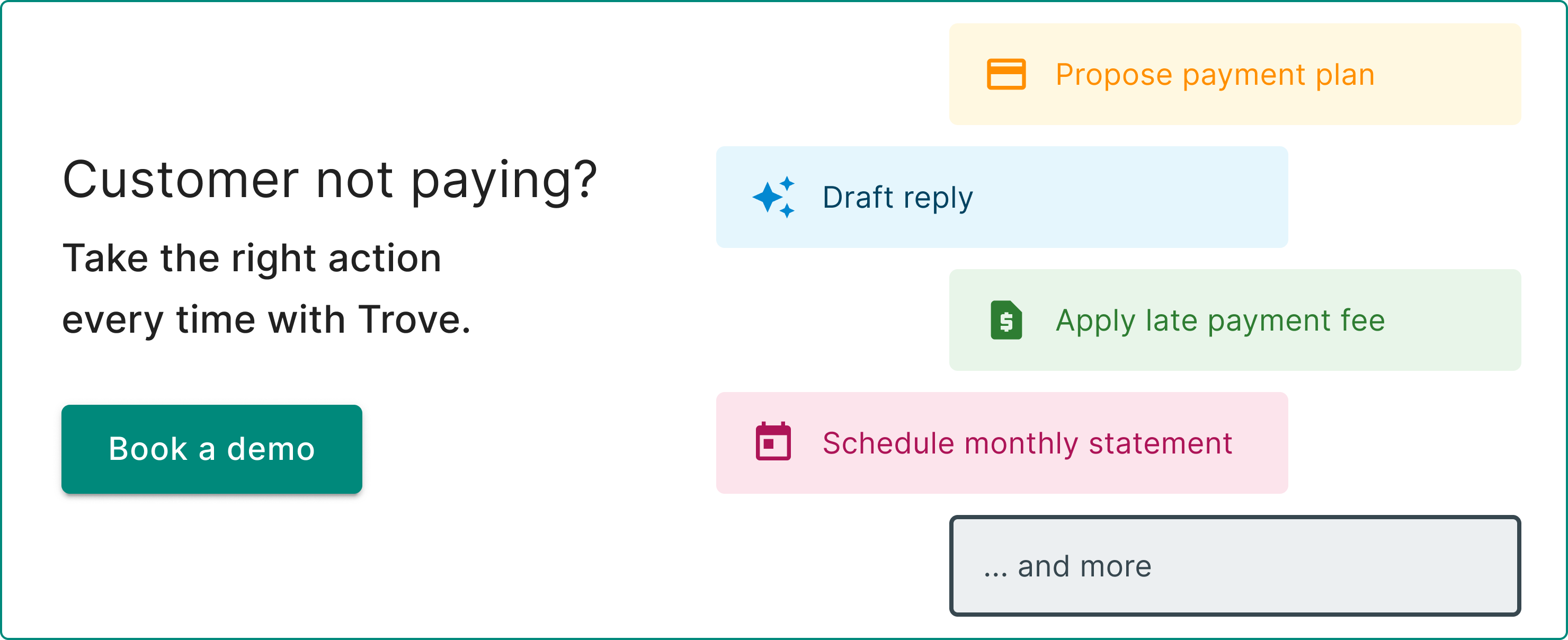
Trove solves every edge case
Trove takes the right approach with each debtor to get invoices paid on time, every time.
👉 Book a demo 👈
With the system up and running, maybe it's time for you to enjoy a break to Fiji.

