No one enjoys chasing invoices. Sending reminders can make business owners feel like they are being pushy or even risking their customer relationship.
But it’s very unlikely your customers see it that way. When was the last time a supplier emailed asking for payment and you got annoyed? Most of your customers will thank you for the reminder and pay quickly. In fact, 80% of overdue invoices get paid after just two reminders.
The hard part is often just getting started and knowing what to say. To that end, here are five templates you can use to get the ball rolling on collecting those overdue invoices. They are written in a warm, professional tone that assumes most customers genuinely intend to pay - they’ve just got busy, lost the invoice, or let it slip. A human nudge is usually all it takes.
We have also included breakdown of likelihood of payment at each stage to keep your motivation high as you start sending those reminders.
Good practice for all templates
At the start, always assume good intent. Your job throughout is to make paying as easy as possible and to remove whatever small barrier is sitting between your customer and making the payment.
That means every email should:
- Remind them of the specific invoice (number, amount, due date)
- Give them the steps they need to make payment
- Be easy to reply to if they have a question
- Sound like it came from a person, not a system
If initial emails don’t do the trick, you can step up the consequence of non-payment but keeping emails calm and professional still keeps your chances of payment the highest.
Template 1: The friendly first reminder (1–3 days overdue)
This goes out shortly after the due date passes. The tone is light - you’re assuming this is an oversight, not a problem. Many invoices get paid at this stage with nothing more.
Subject: Overdue invoice #1042
Hi Sarah,
Just wanted to say we haven’t yet received payment for invoice #1042 which was due on 18 April for £1,250.
If you have made a payment in the last day or two, please ignore this - it’s probably still on its way to us. If not, you can find payment details on the attached invoice or via the link below:
[View invoice →](Put your invoice link here)
Thank you for sorting this out.
Kind regards,
James
Likelihood of payment: According to Trove’s analysis of thousands of paid invoices, 58% of customers will pay after just one nudge. This could be all it takes!
Template 2: The gentle follow-up (7–10 days overdue)
No response to the first reminder. Time to follow up, but still keep the tone warm. The customer hasn’t done anything wrong yet - they’ve just been slow.
Subject: Re: Overdue invoice #1042
Hi Sarah,
We still haven’t received payment for invoice #1042 due on 18 April for £1,250.
Could you take a look at this when you get a chance? If there’s anything on the invoice that needs clarifying, or if you’d like to discuss anything, just drop me a line here.
Otherwise payment details are on the attached invoice or via the link below:
[View invoice →](Put your invoice link here)
Thank you,
James
Likelihood of payment: After the second reminder, another 21% of invoices are paid by the debtor. That means your likelihood of payment after two nudges is 80%.
Template 3: The firmer nudge (2–3 weeks overdue)
Now the invoice is meaningfully late. It’s time to shift tone and let the debtor know that you are now taking this seriously.
Subject: Invoice #1042 - now 14 days overdue
Hi Sarah,
I’m following up again on invoice #1042 for £1,250, which was due on 18 April and is now 14 days overdue.
Could you let me know when we can expect payment or flag if there’s an issue?
[View invoice →](Put your invoice link here)
It would be great to get this resolved ASAP so if I can help in any way just let me know.
Thank you,
James
Likelihood of payment: Of all invoices paid, 11% of them are paid after the third reminder. That means your total likelihood of payment after this email is 91%.
Template 4: The final notice (30+ days overdue)
At this point you have made multiple attempts and 90%+ of people intending to pay will have made payment. The 4th email you send should signal that the situation has moved from routine to serious, while still leaving room for the customer to respond before you take further action.
Subject: Final notice - invoice #1042 for £1,250
Hi Sarah,
I’m following up on invoice #1042 for £1,250, which is now 32 days overdue. Despite previous reminders, we haven’t received payment or heard from you regarding this invoice.
I’d ask that you make payment by 4 May, or contact me directly to discuss. You can reach me by replying to this email or calling 07700 900123.
If we don’t hear from you by that date, we may need to consider escalating this matter.
[View invoice →](Put your invoice link here)
I hope we can resolve this quickly and look forward to hearing from you.
Kind regards,
James
Likelihood of payment: We’re now in the long tail where additional emails drive a small incremental likelihood that they will be paid. However, this email is doing three things the earlier ones don’t: it sets a specific deadline, it offers a direct way to make contact, and it introduces the possibility of escalation.
Note that it doesn’t specify exactly what “escalating” means - that’s deliberate. The ambiguity prompts action without committing you to a particular course.
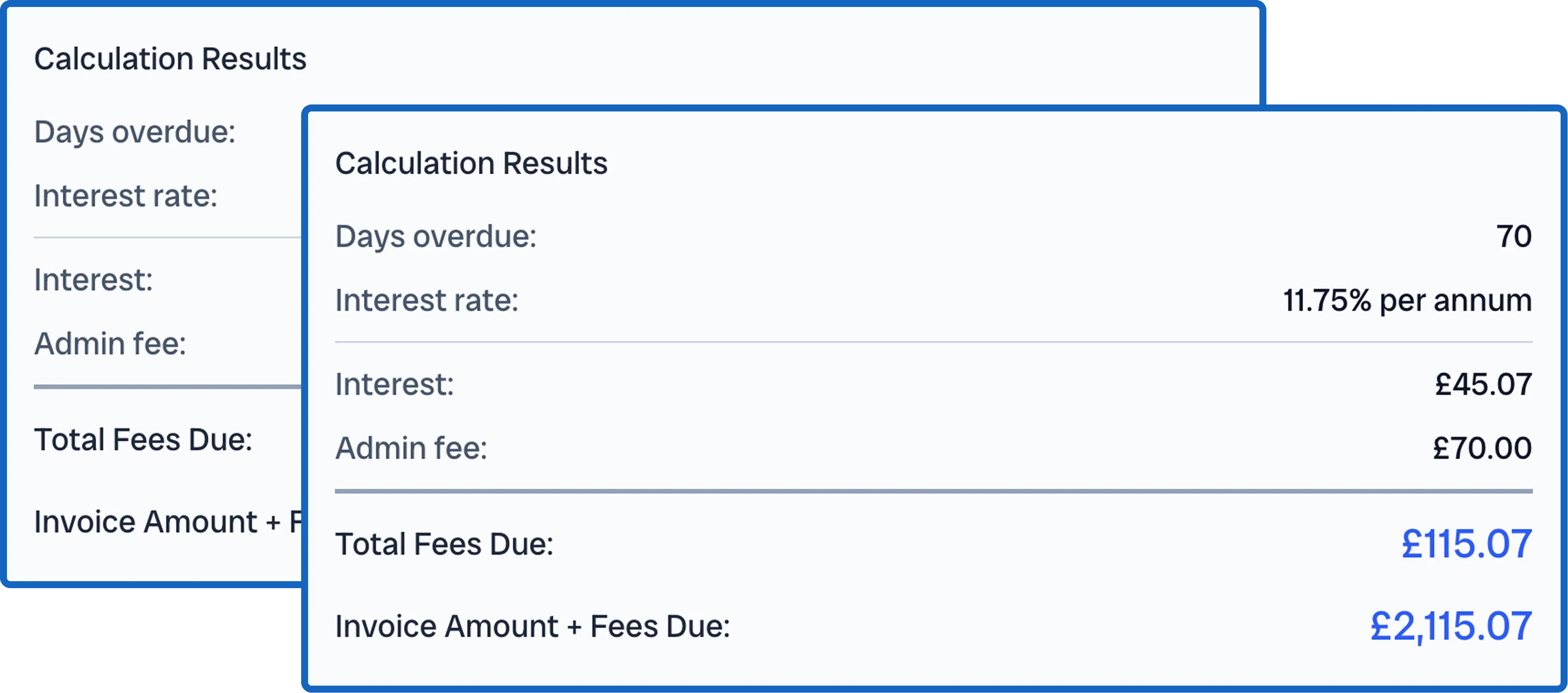
If the amount is significant, this is also a good moment to flag your right to charge statutory interest and late payment fees under the Late Commercial Payments Act. We’ve written a full guide to how those fees work, including a calculator. Sometimes simply referencing this right in the email is enough to prompt payment.
Template 5: The escalation email (after final notice deadline passes)
The deadline in your final notice has passed. This email is short, factual, and leaves almost no ambiguity about what happens next.
Subject: Invoice #1042 - escalation notice
Hi Sarah,
Further to my email on 27 April, I have not received payment for invoice #1042 for £1,250, nor any communication regarding this matter.
I am now formally notifying you that if payment is not received by 11 May, we will begin the process of instructing a debt recovery service.
We would prefer to resolve this without taking that step. If you’d like to discuss, please reply to this email or call 07700 900123.
[View invoice →](Put your invoice link here)
I hope to hear from you soon.
James
Likelihood of payment: Often just mentioning debt recovery is enough to prompt a debtor to make payment. However, note that you should only send this email if you genuinely intend to follow through - empty threats undermine your credibility with this customer and future ones.
How to structure your chase sequence
Here’s how these five templates map onto a typical collection timeline:
| Days overdue | Template | Tone |
|---|---|---|
| 1–3 days | Template 1: Friendly first reminder | Light, assuming oversight |
| 7–10 days | Template 2: Gentle follow-up | Warm, opens dialogue |
| 14–21 days | Template 3: Firmer nudge | Direct, asks for timeline |
| 30+ days | Template 4: Final notice | Serious, sets deadline |
| After deadline | Template 5: Escalation | Formal, states consequences |
Most invoices get resolved somewhere in the first three stages. If you are consistently moving to the 4th or 5th template, there may be something wrong with your process. It might be too difficult for customers to follow or invoices might consistently be landing in spam.
In these cases, automation can help. Trove runs a free 30-day trial and most users see at least one invoice paid during the first 7 days. You can sign up for a free trial here: https://app.trove.works/signup
Common questions
How many reminders should I send before giving up?
There’s no universal rule but most businesses find that three to five well-spaced reminders is the right range before involving a third party. Sending too many too quickly can feel aggressive; leaving too long a gap gives the impression you’re not serious. We’ve analysed when reminders are most effective here.
Should I call as well as email?
For significant amounts or long-standing clients, yes. A brief phone call before or after the third or fourth reminder is often the fastest way to unblock things especially if the hold-up is an internal approval process the customer needs to chase on their end.
What if the customer disputes the invoice?
Don’t push for payment on a disputed invoice. Pause your emails and resolve the dispute first. Continuing to chase when there’s a legitimate query damages the relationship and is unlikely to result in payment anyway.
Can I charge interest on late payments?
If you’re a UK business dealing with other businesses, yes - you have a statutory right to charge interest on overdue invoices under the Late Payment of Commercial Debts Act. Our full guide explains how to calculate those fees, with a free calculator.
What’s the difference between using these templates manually vs. using software?
Used manually, these templates require you to remember to send each one, customise the details, and track who’s responded. Software like Trove automates the sequence - the right email goes out at the right time, personalised for each customer, sent from your own inbox so it looks and feels like it came directly from you. That last part matters: customers are more likely to open and respond to an email from a person than from a system.