
Summary
- Large corporate customers pay against a purchase order. If your invoice doesn’t carry a valid PO number, their accounts payable system can’t match it and the invoice gets stuck.
- The PO number typically lives in the Reference field on a Xero invoice. The goal is to get a valid PO into that field before the invoice falls due.
- Xero can send a reminder before the due date, but it can’t route that reminder to the person who actually holds the PO.
- Three ingredients get the PO in on time: (1) a reminder asking for a PO (2) sent to the right contact (3) at the right time i.e. before the invoice is due.
- Trove sends pre-due reminders from your own email address, routed to whichever contact holds the PO, so the request lands with procurement while your overdue chasers still go to accounts payable.
Why are PO numbers so difficult to lock in
When you invoice a small business, the person who receives the invoice is usually the person who pays it. When you invoice a large corporate, that isn’t how it works.
Big companies run their accounts payable on a three-way match: the invoice, the goods-received note, and the purchase order all have to line up before anything is paid. The PO number is the key that lets their system find the budget the spend was approved against. No PO number = no match = no payment. The invoice sits in a holding pile marked “on hold” or “parked” until someone chases down the missing reference.
The frustrating part is that this has nothing to do with whether your work is complete. A perfect invoice with a missing PO is worth exactly as much as no invoice at all. We’ve broken down why this happens in more detail here.
Why chasing a PO number after the due date is too late
Corporate finance teams pay on runs, often weekly, sometimes fortnightly or monthly. To get into a payment run, your invoice has to be clean and matched a few days before the run closes.
If it’s still missing a PO on the due date, it has already missed that window. A single missed run can turn 30-day terms into 45 or 60 days.
So the goal here is to get the PO number onto the invoice before it falls due.
The three ingredients required to get the PO on time
-
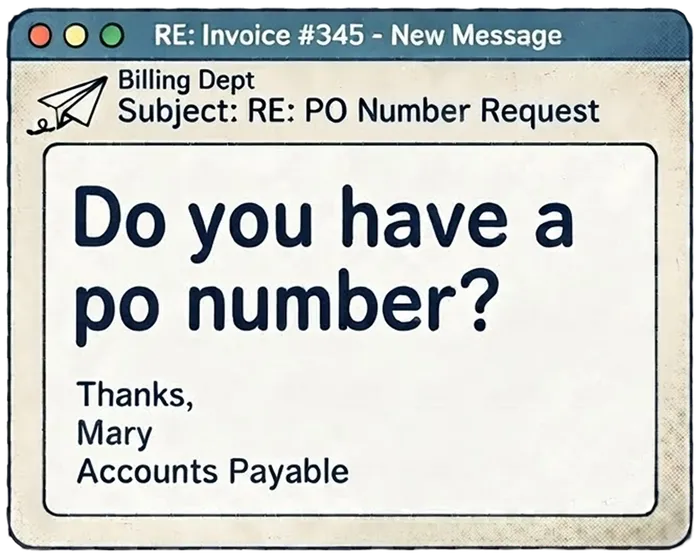
Send a reminder. If you do not have a PO number on your invoice, you need to ask for one. A short, friendly will do it: “here’s the invoice, please confirm the PO so we can get it onto your next run”.
-
Send it to the right person. In larger finance teams, the person issuing the PO number is often different to the person who is paying the invoice. That means you will have to get the PO number from one person, put it on the invoice and then submit the invoice to a second person. Sending your initial reminder to the right person saves a lot of back and forth.
-
Send it at the right time. Always ask for missing PO numbers at least a week before the invoice is due. This gives you a much better shot at making sure your invoice is paid on time and makes you look professional to the customer. If you are constantly scrambling for PO numbers a week after the invoice’s due date, it will add stress to the entire process.
Where Xero stops and Trove picks up
Xero can send a scheduled reminder before the due date. What it can’t do is send that reminder to a different person than your normal chasers.
This is important. The PO typically comes from procurement. The payment comes from accounts payable. Xero sends every reminder to whichever contacts are flagged on the customer record, on one schedule, from @xero.com.
Trove gives you the flexibility to send different reminders to different people. For example, a reminder set to “-10 days” goes out ten days before the due date, from your own email address, routed to whichever contact you choose.
This means you can set the process up once with the right contacts and then sit back and watch the PO numbers roll in each time.
Trove runs a free 30-day trial and takes about five minutes to connect to your Xero account.