
Summary
- What is credit control software. Software that chases your unpaid invoices for you. Sold as debtor management, dunning or AR automation depending on who is selling it.
- How to compare tools. What automation should do without you, where AI genuinely helps and where it’s hype, and when to switch from chasing manually. Jump to automation and AI
- Pricing for credit control software. From £8/month for statements only to £650/user/month for enterprise platforms. Average ~£50-100. Jump to pricing
- Credit control software comparison. Ten tools with pricing, ratings and reviews for each. Jump to the providers Jump to reviews
- How to choose. Three questions: do you need the extras, what is your budget and who is doing the chasing.
- By business size. Shortlists for small businesses and SMEs, finance teams, and enterprises and corporates. Jump to business size
Which credit control software suits you
Start with how you work today. Then check what each tool’s AI does with customer replies, because that’s where tools differ most.
| If you… | Look at | Published price from | Free trial |
|---|---|---|---|
| Only want customer statements sent from Xero | Statey | £8 a month | 32 days |
| Use Sage | Credit Hound | £51 a month | Yes |
| Want reminders with UK credit data | Satago | £45 a month | Yes |
| Want to save time on credit control by using AI | Trove | £50 a month | 30 days |
| Have a UK mid-market finance team | Chaser | £199 a month | 10 days |
| Need a full AR platform across a large or enterprise business | Kolleno or Upflow | £650 per user a month (Kolleno), on request (Upflow) | Not published |
The full table of all 10 tools, with ratings and review sources, is further down this page.
What is credit control software
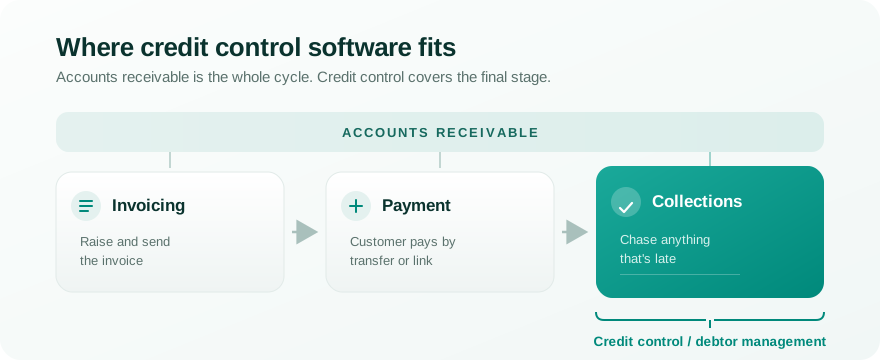
Getting paid has three stages:
- You send the invoice
- Most customers pay
- You chase anything that’s late
Accounts receivable covers all three. Credit control software automates the final stage: chasing down overdue invoices.
Accounts receivable vs credit control software: what’s the difference?
Accounts receivable software covers the whole invoice-to-cash process: raising invoices, taking payment and chasing what’s late. Credit control software handles the last part. It reads your ledger, chases overdue invoices and writes the activity back. If your accounting system already raises invoices and takes payments, credit control software is the piece you’re missing.
You’ll also see it sold as credit management software. Strictly, credit management starts earlier: checking a customer and setting a credit limit before you give them terms, then collecting what they owe. You may already use a company like Creditsafe or Atradius to do your credit checking, so check your credit control software integrates with them.
The same product gets sold under four names, which can make comparing tools tricky.
| Term | What it covers | Where it’s used |
|---|---|---|
| Accounts receivable (AR) | The whole invoice-to-cash process: raising invoices, taking payment, chasing what’s late | The umbrella term, used everywhere |
| Credit control | Chasing overdue invoices, plus credit risk and limits | Mainly UK |
| Debtor management | Effectively the same as credit control | Mainly Australia and New Zealand |
| Dunning | The automated chasing sequence, usually without the credit risk side | Mainly US, and in software documentation |
Searching for debtor management software or dunning software will surface broadly the same tools as credit control software. Searching for an accounts receivable platform gives you a wider, heavier feature set and a higher price.
Debtor management software
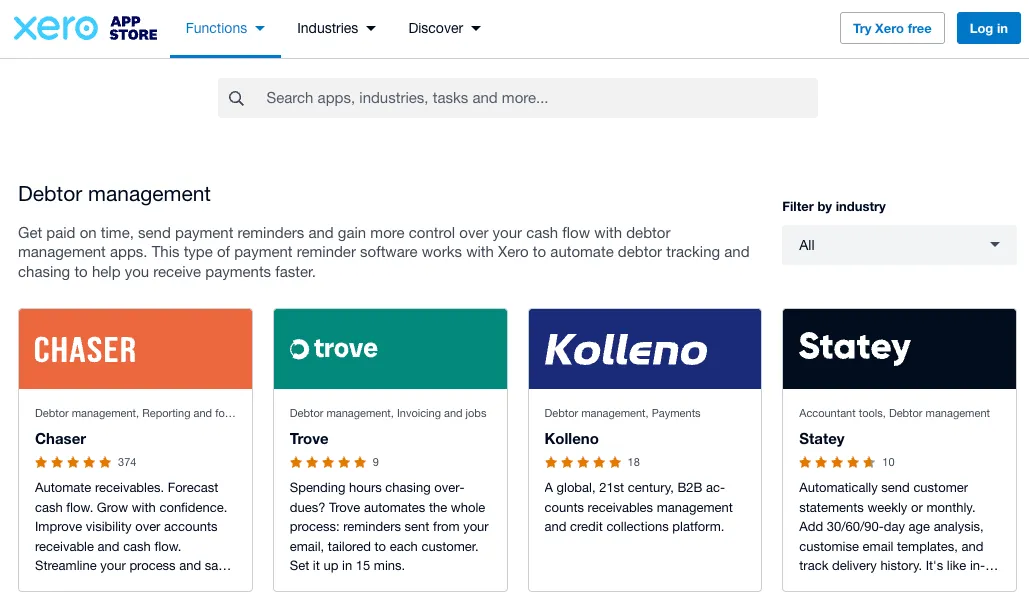
Debtor management software is credit control software under a different name. The term is standard in Australia and New Zealand with the Xero App Store, for example, using “debtor management” as the category name.
However, there are no major feature differences to look for when compared to credit control software.
Dunning and dunning management
Dunning is most often used in the US to describe the automated chasing sequence: the series of reminders that goes out at set intervals after an invoice falls due.
It’s narrower than credit control. Dunning describes the automated sequence while credit control covers all the work needed to collect the invoice: apply late fees, reporting, payment plans.
Subscription billing platforms like Stripe often sell “dunning” as a feature for failed card payments. For tools sold specifically on the dunning label, see what affordable dunning software costs.
What credit control software costs
Published prices in this category run from £8 a month to £650 per user per month. The more expensive platforms generally sit in the ‘full AR platform’ band and include invoicing and payments. Some platforms (like Chaser) straddle two bands with two different pricing plans.
| Band | Monthly price | What you get | Tools |
|---|---|---|---|
| Statements only | £8 to £40 | Automated statements with age analysis, no chasing workflow | Statey |
| Credit control focused | £45 to £199 | Reminder sequences, sending from your domain, Xero sync, reporting | Satago, Trove, Credit Hound, ezyCollect, Chaser |
| Full AR platform | £599+ or on request | Invoicing, payments, collections, advanced reporting | Chaser, Kolleno, Upflow |
The top band is worth it if you have a large finance team and want to move all accounts receivable work into one platform. Most SMBs using Xero only need a platform that is focused on credit control as Xero often covers both invoicing and payments.
Most tools run some kind of free trial: Chaser offers 10 days, Trove offers 30 and Statey offers 32. A trial tests the things a pricing page won’t tell you: how fast setup actually is, how support responds when something breaks, and whether you recover any money during the trial window itself. Here’s what to test on a credit control software free trial, and which tools offer one.
Compare credit control tools on automation and AI
Every tool in this category claims automation and most now claim AI too. Here’s an overview of the features that will move the needle on saving time and faster collections.
Credit control automation: what to look for
Every automated credit control platform sends reminders. The best automated credit control software stands out on the must-haves below, particularly workflow flexibility and sending from your own domain.
| Feature | Must-haves |
|---|---|
| Scheduled reminders - go out before and after the due date without anyone pressing send | • Sending from your domain • Different sequences for different customer types • Emails with different triggers (due date, customer type) |
| Escalation rules - change the tone, channel or recipient as an invoice ages | • Ability to vary recipient for different emails • Slack or Teams alerts to keep your team in the loop • Categorisation into good and bad payers |
| Late fee calculation - works out UK statutory interest and recovery fee and raises the invoice | • Per-customer control, so you can apply fees to persistent late payers and waive them for accounts you don’t want to upset. |
| No chase slipping through - every unpaid invoice stays in a sequence until it’s paid or paused | • Two-way accounting sync with your accounting software • Notes, tasks and an audit trail |
| Reporting - a clear view of what’s overdue, outstanding and paid | • Flexible reports to show clearly who has paid, who’s still outstanding and what the next steps are |
Which integrations matter depends on your stack: Creditsafe for credit checks, Xero with Outlook and Teams for Microsoft 365, or Xero with Gmail and Slack for Google Workspace. If you invoice through Stripe, see invoice chasing software for Stripe users.
AI in credit control: what’s useful and what’s overhyped
AI is now a key thing to assess when you choose credit control software. Put AI at the top of your shortlist criteria, and ask each vendor to show you a real example.
Here are some core ways AI can improve the efficacy of your credit control:
- Writing reminders that don’t read like a template. Customers learn to ignore the same email arriving every seven days. Varied wording that references the actual invoice gets read.
- Handling replies. “Paid yesterday”, “wrong contact” and “we’re disputing this” each need a different response. AI that reads replies and pauses, updates or flags the invoice saves more time than AI that writes the emails.
- Flagging deteriorating payment behaviour, such as a customer who used to pay in 20 days now taking 45, before it becomes a bad debt.
The hype is mostly in two places. Some tools label fixed rule-based schedules as “AI”, which is ordinary automation. Others promise fully autonomous chasing with no human review, which can be risky. Be wary of any tool that sends AI replies unreviewed from day one.
Automated vs manual debtor management: when to make the switch
Whether to switch comes down to three tipping points. You’re raising more invoices than one person can track from memory, usually around 30 to 50 a month. Someone spends more than two or three hours a week writing chasers. Or your late payment rate is creeping up because reminders go out when someone has time, not when they’re due.
If any of those sound familiar, an automated credit control tool will usually pay for itself in time saved. Our guide on how to automate credit control covers setup step by step. For the full comparison, see credit control software vs a manual process.
Credit control software comparison: pricing and ratings
Tools here fall into two groups. Chasing-focused tools do collections and little else, and cost less. Full AR platforms handle invoicing and payment as well, and cost more.
| Tool | Best for | Pricing | Rating | Free trial |
|---|---|---|---|---|
| Statey | Automated Xero statements only | £8/mo | 4.6/5 (10) - Xero | 32 days |
| Satago | UK SMBs wanting Experian credit data built in | £45/mo | 4.5/5 (129) - Trustpilot | Yes |
| Trove | SMBs who want AI to turn “I’ll pay Friday” into a logged payment date and a drafted reply | £50/mo | 5/5 (11) - Xero | 30 days |
| Credit Hound | Sage users | £51/mo | 5/5 (12) - Sage | Yes |
| ezyCollect | SMBs who want a customer payment portal | ~£98/mo | 4.7/5 (25) - G2 | Not published |
| Chaser | UK mid-market finance teams | £199/mo | 4.3/5 (70) - G2 | 10 days |
| Kolleno | Mid-market and enterprise collections teams | £650/user/mo | 4.9/5 (117) - G2 | Not published |
| Lunos.ai | B2B AR teams who need AI dispute handling | 0.3% | 4.8/5 (3) - G2 | Not published |
| Paraglide | High-volume B2B finance teams | On request | 5/5 (9) - G2 | Not published |
| Upflow | B2B SaaS and scaling companies, often US | On request | 4.8/5 (234) - G2 | Not published |
All pricing accurate at time of publishing.
For the detail on any of these:
- The three heavier platforms head to head, in Chaser, Kolleno and Upflow compared
- The sub-£100 tier, in our shortlist for UK small businesses
- Xero-specific picks, in the best invoice chasing software for Xero users
- Individual alternatives round-ups for Chaser, Satago, ezyCollect and Statey, plus Credit Hound pricing and alternatives
Credit control software reviews and ratings
Every tool in the table above rates somewhere between 4.3 and 5 out of 5, so the stars alone won't separate them. Below are reviews from real customers: a summary of the themes, then two sample reviews. The first shows what people love about the tool. The second shows the most common criticism or limitation.
Each rating comes from the platform with the most reviews to go on. Trove's own reviews are newer and fewer than the established tools here, so weigh the evidence accordingly.
Statey reviews and ratings
Reviewers love: Aged statements with 30, 60 and 90-day breakdowns, which Xero doesn't do.
Statey has 10 reviews on the Xero App Store, averaging 4.6/5, posted between July 2023 and August 2025. Nine are five stars, and nearly all of them praise the same thing: aged statements with 30, 60 and 90-day breakdowns, which Xero doesn't produce on its own.
There's just one criticism and it's old. A one-star review from October 2023 reports that incorrect statements went out to a whole customer base. Statey replied that it was a timing clash with automatic recurring invoices in Xero and that it has since changed its interface to warn users about it. Here's a deeper dive on what Statey costs and how it compares.
Age analysis (not available in Xero)
Excellent add-on, showing outstanding items, age analysis (not available in Xero), payments received and allocations of those payments and activity. Lots of other settings and choices. A must to have for effective debtors control.
Elma Harvey
Xero App Store, 1 Apr 2025
Incorrect statements sent
Sent incorrect statements to our entire customer base.
Lauren Anderson
Xero App Store, 13 Oct 2023
Satago reviews and ratings
Reviewers love: Invoice finance that's quick and easy to manage.
Satago's largest review base is Trustpilot, at 4.5/5 across 129 reviews. Most of those date from late 2022, and the most recent is January 2025. Reviewers mostly rate the invoice finance side: moving money quickly and managing invoices.
The criticism is price. One reviewer reported a 220% rise on their own plan in 2025, and said Satago told them the smallest increase any customer would see was 80%. That's one review out of 129, so treat it as a prompt to confirm current pricing rather than as what everyone pays. Here's how Satago compares with the alternatives, or see Chaser vs Satago.
A seamless solution
Satago has provided a seamless solution through its invoice factoring services. The platform is user-friendly and integrates smoothly with our accounting software, making the process of uploading and managing invoices incredibly straightforward.
Accounts Department
Trustpilot, 5 Jun 2024
220% price increase
The price increase equates to a 220% increase to allow us to use the features we currently use. The minimum price increase for any customer is 80%.
LightPath IT
Trustpilot, 1 Jan 2025
Trove reviews and ratings
Reviewers love: Value for money and how quickly feedback is turned into new features.
Trove has 11 reviews, all five stars, all on the Xero App Store. It's newer than most of the tools here, so there's less to go on. Reviewers rate the price and how easy it is to use.
There are no negative reviews yet but the honest limitation is scope. The second reviewer below highlights this: Trove does credit control and nothing else. It doesn't do invoice financing, credit risk scoring or advanced AR analytics, which is how it stays at £50 a month.
A third of what we paid before
We now pay 1/3 of what we paid with someone else, and yet Trove is far easier to use and gives the same service as we need.
Daniel Everall
Xero App Store, 18 Sep 2026
The essentials, without the extras
If you're looking for a credit control tool that focuses on doing the essentials really well without unnecessary extras, Trove is definitely worth considering.
Wendy Parkin
Xero App Store, 25 Feb 2026
Credit Hound reviews and ratings
Reviewers love: Seamless integration with Sage, including automatic syncing.
Credit Hound has 12 reviews on the Sage UK Marketplace, all five stars, posted between April 2022 and September 2026. Reviewers say the automated chasing gets them paid faster and the integration with Sage is excellent. One likes being able to mark invoices as disputed, which pauses the chasing until the issue is resolved.
The only problem mentioned in the six most recent reviews came from the latest reviewer, who had trouble with how their email address displayed. Credit Hound's team fixed it on a call. The same reviewer also praises the Sage integration, which syncs automatically every 15 minutes. Here's what Credit Hound costs and how it compares.
We get paid a lot quicker
We get paid a lot quicker since using the software and can rely on it to chase the smaller monies so we can concentrate on larger debtors.
Thea Walker
Sage UK Marketplace, 16 Dec 2025
Simply basic but in an excellent way
We have been using Credit Hound for a couple of years, and found its functionality simply basic but in an excellent way. It auto links to Sage (we have set to 15 mins) and makes debt chasing much easier, and streamlined. We had an issue with the way our email address was presenting, but a teams call with Manvir got that all resolved.
Samantha Roscoe
Sage UK Marketplace, 16 Sep 2026
ezyCollect reviews and ratings
Reviewers love: Integrated payments via Pay Now.
ezyCollect has 25 reviews on G2, averaging 4.7/5. Most were posted between 2022 and 2024, before Sidetrade bought the company in 2026. Reviewers mostly praise the automated reminders running in the background. The most recent review, from March 2026, singles out the payment writeback and the Pay Now button.
The most common complaint is syncing. Four of the ten most recent reviews mention syncing problems or data not matching between ezyCollect and their accounting system, all from reviewers who still gave four or five stars. Here's what ezyCollect costs and how it compares.
Achieves results in the background
EzyCollect is reliable, efficient and achieves results in the background while you get on with the day to day of running your business rather than chasing late payments.
Brad L., director, mid-market
G2, January 2024
Doesnt update and sync
To be honest, there is not much we dislike. Maybe just the updating contact details in Xero sometimes doesnt update and sync with Ezy collect. That could be better.
Durgesh J., director, small business
G2, November 2022
Chaser reviews and ratings
Reviewers love: Integrations and email scheduling, with quick setup.
Chaser rates 4.3/5 across 70 reviews on G2, the platform with its most recent reviews. It's 5/5 across 374 on the Xero App Store, but there's no criticism in any of those, so G2 gives the more useful picture. Reviewers rate the integrations and the email scheduling, and say setup is quick.
The most common complaint is that reporting is too limited, followed by how the emails work. Cost is also highlighted as below. However, this reviewer still gave Chaser five stars overall. Here's the full Chaser pricing breakdown and the alternatives.
We integrated with our on-premises Sage 200 in just five minutes
We integrated with our on-premises Sage 200 in just five minutes, making it the easiest integration I have ever experienced.
Ashley C.
G2, October 2025
Expensive
Expensive especially if used for multiple companies. However it is worth the cost as it means we don't need to expand headcount.
Eshan S.
G2, April 2026
Kolleno reviews and ratings
Reviewers love: It takes reconciliation off the team's plate.
Kolleno rates 4.9/5 across 117 reviews on G2, and its ten most recent were all posted in July and August 2026. Reviewers praise how much routine chasing and reconciliation work it takes off their team, and two single out the customer payment portal.
The most common request is for more control over the layout. Four of the ten most recent reviews ask for more customisable dashboards, invoice tables or interface, all from reviewers giving four and a half stars. Here's what Kolleno costs and how it compares.
Used to require a massive amount of manual effort
I appreciate how Kolleno automates routine tasks in credit control and cash flow management, which used to require a massive amount of manual effort.
Mark M., small business
G2, August 2026
More fully customizable
While the default analytics suite provides solid data out of the box, I do wish the main user dashboard was more fully customizable.
Jean K., mid-market
G2, August 2026
Lunos.ai reviews and ratings
Reviewers love: Big drops in overdue balances.
Lunos.ai has three reviews on G2, averaging 4.8/5, all posted within two days of each other in August 2026. That's very little to go on either way. All three report big drops in overdue balances, and two describe the same ramp-up: they ran the AI in a mode where it suggests actions for approval, then moved customers over to letting it act on its own once they trusted it. One also says actions can be slow to regenerate.
If you're expecting to switch it on and walk away on day one, plan for a few weeks of supervision instead.
DSO fell from 175 days to 51
In about three months our DSO fell from 175 days to 51, a 71% drop, and collections went up 111% over the same period.
John M G., financial controller, small business
G2, August 2026
Took some trust-building at the start
Getting comfortable enough to move customers into full Act mode took some trust-building at the start. After the first month that hesitation was gone.
Richard A., assurance manager, mid-market
G2, August 2026
Paraglide reviews and ratings
Reviewers love: AI agents that clear the finance inbox, answering billing queries and chasing in a human tone.
Paraglide has nine reviews on G2, all five stars, posted between January and April 2026, mostly from mid-market finance teams. It's a young product with a small review base. Nearly every reviewer describes the same thing: AI agents clearing a busy finance inbox by answering billing queries and chasing overdue customers in a way that doesn't read like an automated reminder.
None of the reviewers raises a real problem. The nearest thing to a limitation, mentioned by two of them, is that the product is changing quickly.
Followed up automatically in a way that feels human
Paraglide transformed our Accounts Receivable operations. Their AI agents now handle the majority of our billing queries, and overdue customers are followed up automatically in a way that feels human.
Stephanie C., finance operations manager, mid-market
G2, February 2026
Occasional changes that require a bit of adjustment
The product is evolving quickly, so there are occasional changes that require a bit of adjustment. That said, the team is very responsive to feedback.
Verified user, staffing and recruiting, mid-market
G2, March 2026
Upflow reviews and ratings
Reviewers love: Intuitive, detailed reporting.
Upflow rates 4.8/5 across 234 reviews on G2, with reviews up to July 2026. Reviewers value the reporting, and it's also what they most want improved: two separate five-star reviewers asked for more control over report formats, custom fields and building their own AR dashboards.
The part reviewers are least happy with is how the reminder email looks to the customer receiving it, though that complaint comes from one reviewer, who still gave four stars. Here's what Upflow costs and how it compares.
Easy to generate reports
I appreciate how easy it is to generate reports, whether I need a summary that covers all customers or a detailed report for a specific individual. I also find it helpful to quickly look up payments and see exactly which invoices have been paid.
Veronica C.
G2, January 2026
Seems a tad bit scammy
I think the actual deliverable, the email, seems like a tad bit scammy. Because it provides a link and there's payment information. We did put our custom signature in there, but I wish it was a little bit more professional looking.
Zack M.
G2, December 2025
How to choose
Three questions, in order.
1. Do you need the extras yet?
Advanced reporting, CRM integrations and risk scoring sit on higher tiers or heavier platforms. Most small businesses don’t need them yet. If you’re unsure, pick a tool with a real entry-level plan and an upgrade path rather than buying capability you might grow into.
For corporate groups weighing up a full platform, we’ve compared enterprise credit control software vendors on price, ERP integrations and security. If you invoice from Dynamics, see credit control software for Business Central.
2. What is your budget?
Work out the number you’d actually pay at your volume, not the headline. Per-user and percentage models diverge from the advertised price fastest.
3. Who is doing the chasing day to day?
An owner or director doing it themselves wants something that mostly runs itself, which points to the chasing-focused end - see credit control software for UK small businesses for that shortlist. Once it’s more than one person, coordination becomes the harder problem - see what finance teams need. For a large business or corporate group running several entities, the enterprise comparison below covers pricing at scale, ERPs and security.
And if nobody owns it, because chasing is one job among several, that’s a different shortlist again. If the person chasing also owns the client relationship, that’s its own problem - see credit control software for agencies. An accounting firm chasing its own fees has a version of the same problem, plus late fees and workflows worth reusing across clients - see credit control software for accountants. If some of your customers are abroad, see our guide to chasing unpaid invoices from overseas customers.
If you’re still unsure, start at the £45 to £50 entry point with Satago or Trove and upgrade if you outgrow it. Once you’ve picked something, here’s how to roll out automated credit control without losing control of the process.
Credit control software by business size
The tools above serve very different businesses. What changes as you grow is who does the chasing and what the tool has to connect to, so the right shortlist looks different for an owner chasing their own invoices, a finance team sharing the work, and a corporate group running several entities.
Credit control software for UK small businesses
Service businesses, construction firms and fast-growing companies tend to carry the most overdue invoices. In a small business, chasing usually falls to the owner or a part-time bookkeeper, between everything else.
It’s time to automate once any of these is true:
- You spend more than an hour a week chasing.
- You have more than ten invoices overdue at once.
- You’re working out late fees manually.
Xero’s built-in invoice reminders are the free starting point. You outgrow them when you need different schedules for different customers, or want reminders to come from your own email address instead of from Xero.
Cost is rarely what stops a small business. Statement tools start under £10 a month and full chasing tools under £55. The accounting system you use narrows the shortlist faster than price does:
| Tool | Best for | Works with | Starting price |
|---|---|---|---|
| Statey | Low-cost statement automation | Xero | £8/month |
| Satago | Credit risk data plus chasing | Xero, QuickBooks, Sage, FreeAgent | £45/month |
| Trove | Chasing and late fees from your own inbox | Xero, QuickBooks, FreeAgent, Stripe | £50/month |
| Credit Hound | Sage users | Sage, Xero, Infor SunSystems | £51/month |
| ezyCollect | Customers paying straight from the reminder | Xero, NetSuite, Sage 300, Sage Intacct, Dynamics 365 | Not published |
If one person does all the chasing, pick something that mostly runs itself and upgrade later if you need to. Read what customers say about Statey, Satago, Trove, Credit Hound and ezyCollect before you decide.
Credit control software for finance teams
Once more than one person chases, coordination becomes a harder problem than reminders. Xero, QuickBooks and Sage record what each customer owes, but not who is handling them. That gap causes the same four problems in almost every team:
- Customers get chased twice by two different people.
- A payment promise sits in one person’s inbox, and nobody else knows about it.
- Nobody can see what’s already been tried with a customer.
- The finance lead can’t get a clear view of receivables without asking around.
These are the features that separate a tool built for a team from one built for a single person:
| What you need | Why it matters | Who it’s for |
|---|---|---|
| Customer ownership | Each customer has a named owner, so nobody doubles up | The team |
| Shared status view | Everyone sees where each overdue invoice stands | The team |
| Payment promise capture | A promised date is logged and followed up automatically | The team |
| Approvals | New team members’ escalations go through a reviewer first | The finance lead |
| Shared templates | Every customer hears the same tone, whoever sends it | The finance lead |
Trove’s Integrated plan is £135 a month with unlimited users, and adds a team kanban board and Slack and Teams alerts. Chaser starts at £199 a month, tiered by revenue, and covers more of the process through to debt collection. Upflow is strongest on reporting, with pricing on request.
If your team already invoices in HubSpot, its own tools cover the basics: invoice owners, automatic reminders and, on Professional and Enterprise plans, ageing reports. HubSpot added an AI collections tool, Revenue Agent, in private beta in September 2026.
Credit control software for enterprises and large businesses
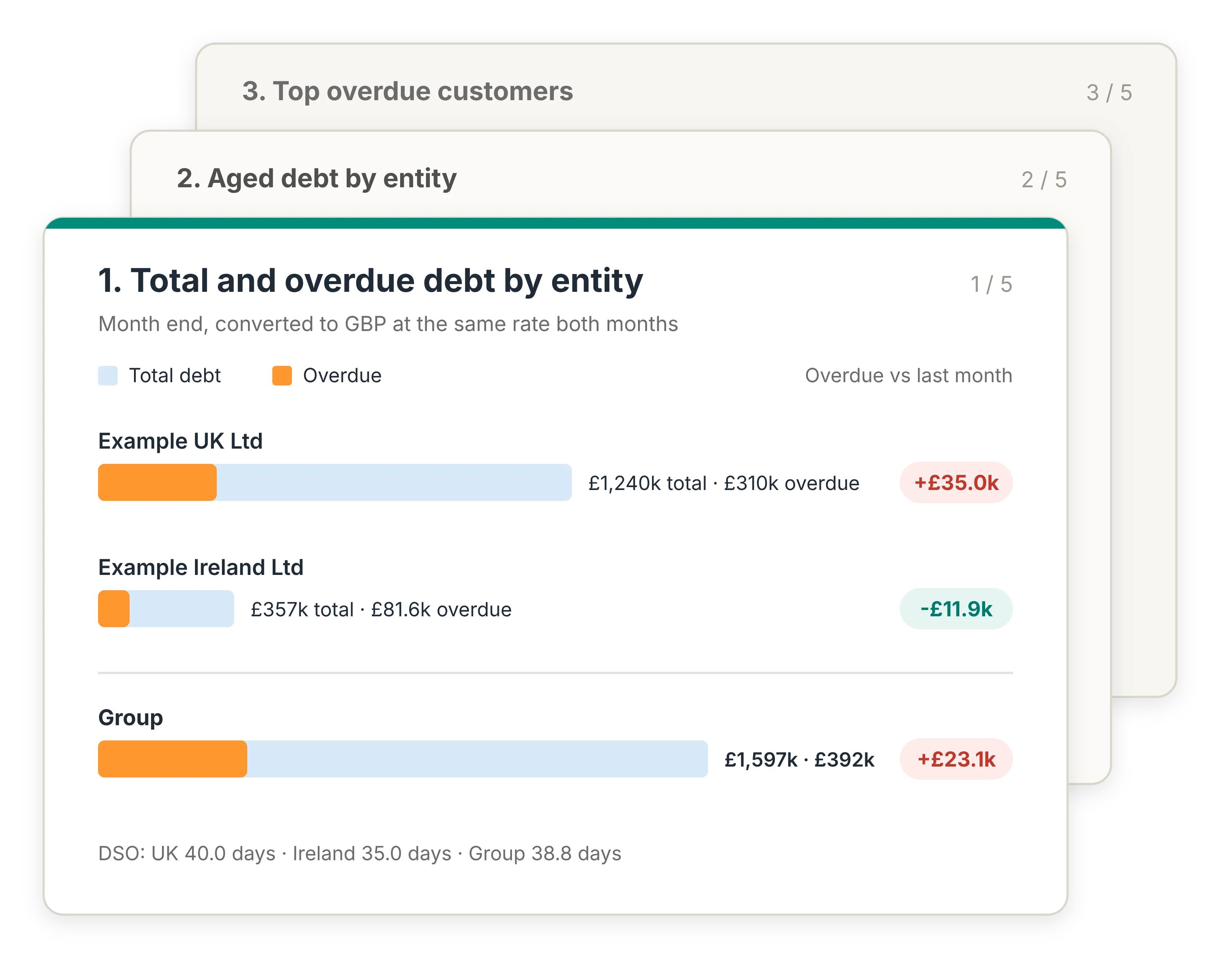
Large businesses and corporate groups chase differently. Teams share the work, invoices run across several ledgers and currencies, and the tool has to connect to an ERP and a CRM rather than just an accounting package.
The first decision is whether you need a full AR platform or a credit control layer. If invoicing and payments aren’t working yet, a full platform like Chaser, Kolleno or Upflow covers the whole invoice-to-cash process, including a payment portal and cash application. If invoicing and payments already run well in your ERP, a full platform duplicates what you pay for. A credit control layer like Trove reads your ledger, chases overdue invoices and writes the activity back, without changing how you invoice.
Prices below assume a business turning over £50m to £100m. Several vendors tier by revenue or seats, so these are higher than the entry prices quoted earlier in this guide:
| Vendor | Price | Pricing model | ERPs | CRMs |
|---|---|---|---|---|
| Trove | £285/month | Fixed, unlimited users and entities | NetSuite, Business Central, Sage | HubSpot |
| Chaser | £899/month | Tiered by revenue | NetSuite, Business Central, Sage Intacct and others | Salesforce, HubSpot |
| Kolleno | £1,245 per user/month | Per user | NetSuite, Business Central, Sage Intacct and others | Salesforce, HubSpot |
| Upflow | On request | Historically a share of collected revenue | NetSuite, Sage Intacct | Salesforce, HubSpot |
Expect IT, security and procurement to ask about four things, so check them before you shortlist:
- Security. An independent certification such as SOC 2 or ISO 27001, a UK GDPR data processing agreement, where data is stored, single sign-on, role-based permissions and an audit trail.
- Implementation. Who does the setup, how long a standard ERP connection takes, and whether you can test in a sandbox first.
- Integrations. How deep the ERP connection goes, whether it reads and writes, and whether alerts reach Slack or Teams.
- Groups. Whether you pay per entity, and whether a process built once can be cloned across every company in the group.
If you’re on Business Central, we’ve compared credit control software for Business Central separately.
Frequently asked questions
Is credit control software worth it for a small business? If late payments are costing you time or cash flow, usually yes. If a £50 tool gets invoices paid a week sooner, it pays for itself quickly. If you have a handful of reliable customers and rarely chase anyone, Xero’s free reminders may be enough. Our guide to credit control software vs a manual process covers how to tell when you’ve outgrown them.
What’s the best software for managing overdue invoices? It depends on your accounting system and who does the chasing. If you’re on Xero or QuickBooks and one person chases part-time, a flat-price tool that sends reminders and statements is usually enough. If several people chase across more than one entity, look at per-user platforms with deeper ERP integration and task management. Prices run from £8 a month to £650 per user per month, so it pays to work out which camp you’re in first. The comparison table above shows price, integrations and ratings for ten tools side by side.
What’s the difference between credit control, dunning and debtor management software? Very little in practice. Credit control is the UK term, debtor management is standard in Australia and New Zealand, dunning is the US term for the automated sequence. Accounts receivable is the wider category that also covers raising invoices and taking payment. Compare tools on what they do, not the label.
Is credit management software the same as credit control software? Mostly, and many vendors use the terms interchangeably. Credit management software usually adds credit checks, credit scores and credit limits for deciding who gets terms. Credit control software focuses on getting invoices paid once they’re sent. If late payment is your problem, credit control software is what you need. If you also want to vet new customers, look for one with credit checks built in, or pair it with a credit reference agency.
What’s the difference between credit control software and a debt collection agency? Credit control is the ongoing process of chasing invoices so they get paid on time, done by you or a tool on your behalf, at a fixed monthly cost. A debt collection agency takes over after that’s failed, recovering the debt for a fee or a cut of what they collect, usually 10% to 25% of the amount recovered for commercial debt, more for balances that are older or harder to collect. Software is prevention. An agency is recovery. Good credit control reduces how often you need one. Here’s when to use each, and how to hand an invoice over.
Which credit control software has the best reviews? On the platforms with the most reviews, Kolleno (4.9/5 across 117 on G2) and Upflow (4.8/5 across 234 on G2) rate highest among the bigger platforms. Credit Hound, Paraglide and Trove are all at 5/5 but on much smaller review bases: 12, 9 and 11 reviews. Chaser is 4.3/5 across 70 on G2. Ratings run higher on marketplaces like the Xero App Store than on independent sites, so compare like with like.
Does credit control software integrate with accounting systems? Almost all of it does, through a two-way sync that pulls in invoices and payment status and writes chasing activity back. Xero is supported by every tool in this guide. QuickBooks, Sage, NetSuite and Business Central support varies by tool and often by plan, so check the plan you’d be on, not just the vendor’s integrations page. Trove connects to Xero, QuickBooks, FreeAgent and Stripe on every plan, and to NetSuite, Business Central and Sage on its Advanced plan.
Can different people chase different customers? Yes, in a tool built for teams. You assign an owner to each customer, and everyone can still see the full chasing history. This is one of the clearest differences between tools built for one person and tools built for a team. See what finance teams need from credit control software.
Do we need a full AR platform, or just collections? If invoicing and payment collection already work, you only need collections, and a full platform would duplicate things you already pay for. If invoicing is the problem, buy the platform. We’ve compared both for large businesses.
Can one tool cover a group of companies? Yes, but check the pricing and the setup. Some vendors charge per entity and others include every entity in one price. Some let you build a chasing process once and copy it to each company, and others make you rebuild it every time.
Can it charge late payment fees automatically? Some tools can. UK businesses can charge statutory interest at 8% above base rate on overdue B2B invoices, plus a fixed recovery fee of £40, £70 or £100 depending on invoice value. Xero won’t calculate or raise these. Tools with late fee automation work out what’s owed and raise it as a separate invoice. Our guide to UK late payment fees covers how to apply them.
Do I need this if I already use Xero’s reminders? Not always. Xero’s built-in invoice reminders are free and fine for simple needs. You outgrow them when you hit the five-reminder cap, need different schedules per customer, find reminders going to spam or the wrong contact, or want to charge late fees.
Can you try credit control software for free? Most tools offer a free trial rather than a free plan. Published trials run from 10 days (Chaser) to 32 days (Statey), and Trove’s is 30 days. Kolleno, Upflow, ezyCollect, Lunos.ai and Paraglide don’t publish a trial length, so you’ll need to ask. Our guide to credit control software free trials compares what each trial includes.
How do these platforms use AI? Trove, Lunos.ai and Paraglide are the most focused on AI. Trove reads customer replies, drafts the response and logs expected payment dates in your accounting software. Lunos.ai uses AI to handle disputes, and reviewers describe starting in a mode where it suggests actions for approval before letting it act on its own. Paraglide’s AI agents answer billing queries and chase overdue customers from your finance inbox. The other tools are less public on how they use AI, so ask to see it in a demo.
Trove is credit control AI for small businesses. It runs a free 30-day trial and connects to Xero in about 15 minutes. You can start a free trial here or book a demo if you’d like to see it first.