

Facts checked September 2026.
Chaser, Kolleno and Upflow all come up when finance teams research credit control software, and getting a straight answer on what any of them costs is harder than it should be. Three of the four tools here price in pounds; Upflow prices in dollars by annual recurring revenue. Here’s what’s publicly known, what isn’t, and what each pricing model tells you about the business it’s built for. For every tool in the market, from £8 statement tools up, see our full credit control software guide.
Credit control software pricing at a glance
| Tool | Starting price | Pricing model | Free trial |
|---|---|---|---|
| Trove | £50/month | Fixed packages, no per-user fees | 30 days, no card |
| Chaser | £199/month | By turnover band | 10 days, no card |
| Kolleno | £650/user/month | Per user, quoted on request | None published |
| Upflow | ~$440/month (unconfirmed) | By ARR, quoted on request | Free analytics-only tier |
Chaser’s bill steps up with your turnover, Kolleno’s grows with every user, and Upflow’s rises with revenue, so three of the four climb as your business does. Trove’s price only changes if you move to a package with more features.
Chaser pricing 2026
Chaser publishes its pricing, which is more than can be said for most tools in this space. Plans scale with your annual revenue.
| Plan | Annual revenue | Price |
|---|---|---|
| Compact | Under £4 million | £199/month |
| Core | Under £10 million | £599/month |
| Complete | Under £100 million | £899/month |
| Custom | Above £100 million | Contact sales |
There’s a 10-day free trial available, with no credit card required.
One thing to watch: A few of Chaser’s features are paid add-ons. SMS reminders, auto-call and the payment portal are all paid so make sure you get a full quote. The jump between bands is steep too - a business that crosses £4 million in turnover moves from £199 to £599/month without changing how it uses the product.
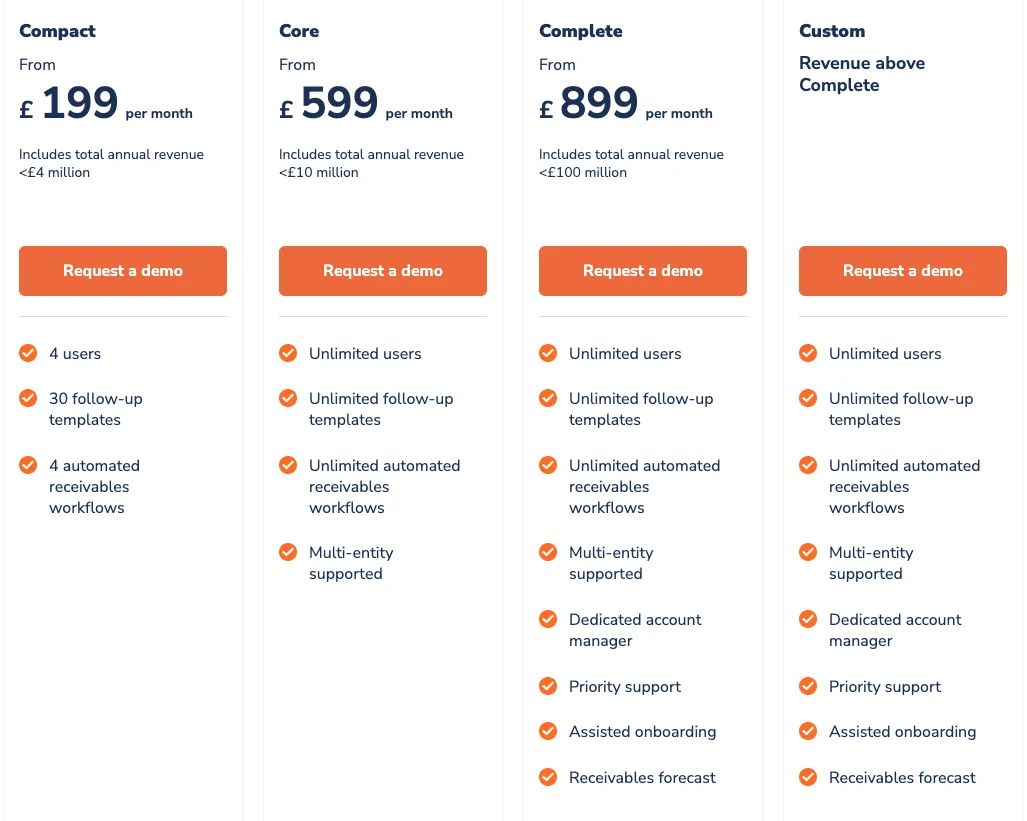 Chaser pricing as of September 2026. Source: chaserhq.com
For a full breakdown of Chaser’s plans, add-ons and reviews, see our Chaser pricing and alternatives guide.
Kolleno pricing 2026
Kolleno publishes per-user figures but still quotes on request, so you go through a demo before you get a real number. The public figures point to an enterprise price point.
| Tier | Pricing basis | Price |
|---|---|---|
| Entry | Per user | from £650 /user/month |
| Higher tier | Per user | around £1,245 /user/month |
| Custom | Per user, plus add-ons | Contact sales |
Per-user figures as of September 2026. Kolleno quotes on request, and pricing varies by company size and requirements.
There’s no published free trial. Onboarding typically takes around 10 days and extra charges can apply for integrations and customisations on top of the per-user fee.
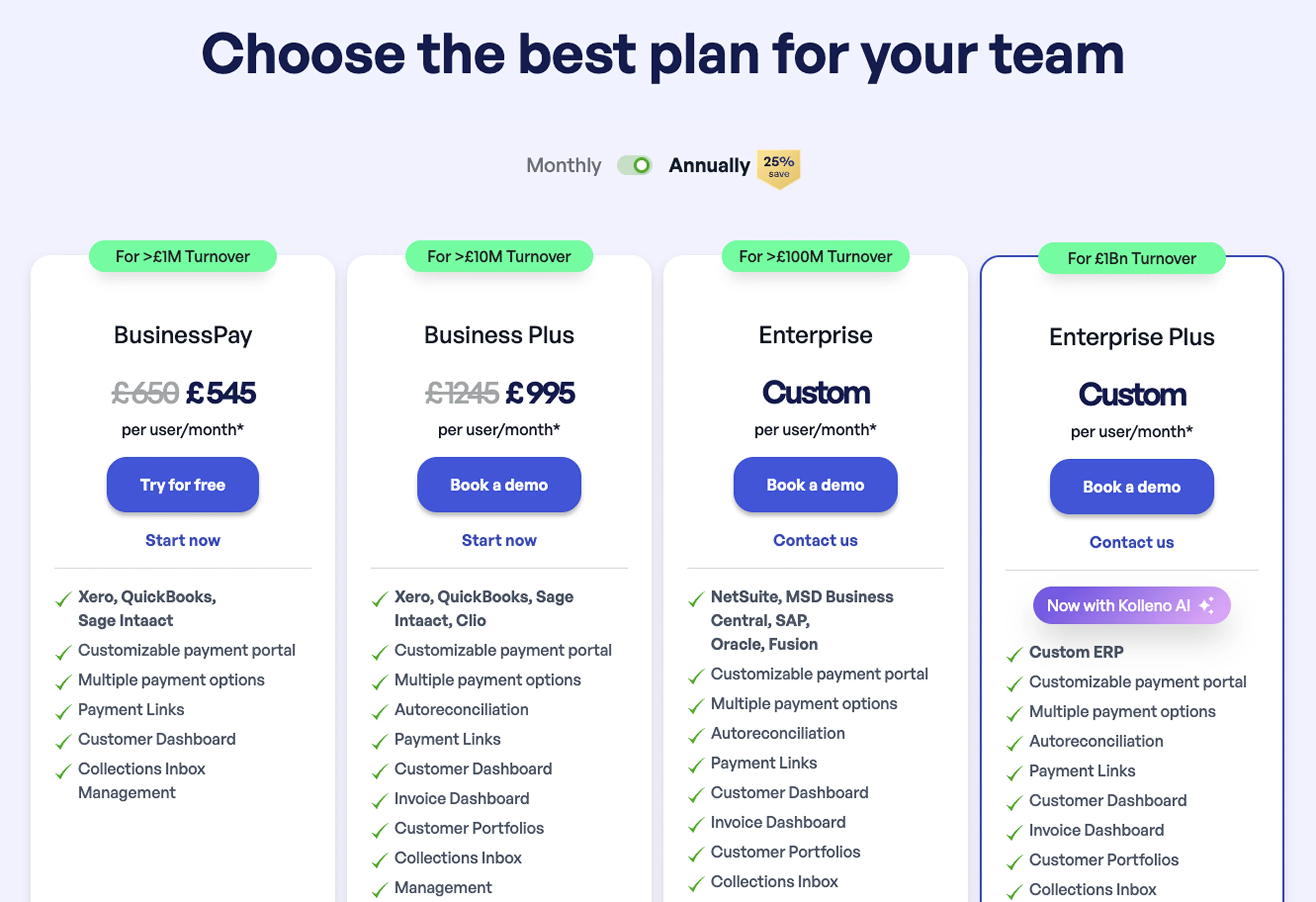 Kolleno pricing as of September 2026. Source: kolleno.com
Upflow pricing
Upflow has a pricing page but it doesn’t list prices. Every paid plan requires you to contact sales and go through a demo before you get a number. Third-party sites like TrustRadius do give some indication on pricing:
| Plan | ARR band | Price |
|---|---|---|
| Discover | Any | Free (analytics only) |
| Grow | $0-$10M ARR | ~$440/month* |
| Scale | $10M-$50M ARR | ~$880/month* |
| Strategic | $50M+ ARR | Unknown |
*Figures sourced from TrustRadius - not confirmed by Upflow directly.
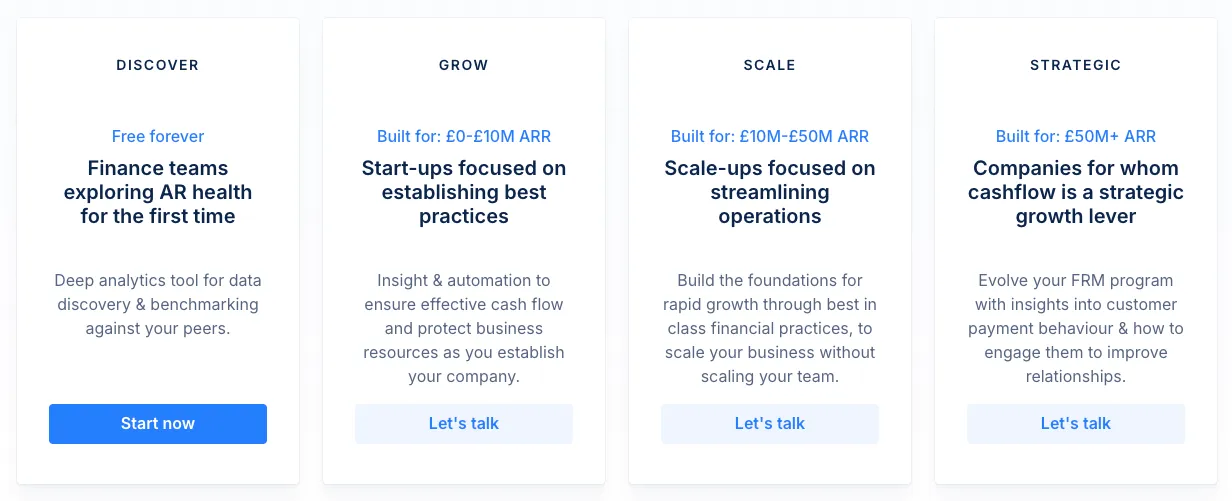 *Upflow pricing as of September 2026. Source: upflow.io/pricing
The free Discover tier is limited to analytics only. You can see your AR data, but you can’t automate any chasing until you’re on a paid plan. There’s no time-limited trial that gives you access to the full tool before you buy.
Why do most credit control tools price based on revenue?
Bigger businesses generally have more complex needs and revenue is an easy way to draw a dividing line on pricing. For example:
- Chaser’s cheapest plan (£199/mo) covers businesses with up to £4m of revenue. It has basic features, allowing only 4 users and up to 30 templates.
- The next plan up (£599/mo) covers £10m of revenue. This plan comes with more advanced features like unlimited users and multi-entity support.
This can be frustrating if you are not using the more advanced features. If you sit at £8m in revenue but only have one entity and a few users, you’ll be paying £599 for limited additional functionality.
If that’s the case, it’s worth looking at credit control software with fixed pricing.
Trove pricing: fixed packages from £50/month
Chaser, Kolleno and Upflow all tie their pricing to the size of your operation: Chaser by turnover band, Kolleno by user count, Upflow by annual recurring revenue.
Trove prices by the features you need. There are four packages, every one includes unlimited team members, and none has a turnover threshold. For small businesses that want affordable credit control software without a price that climbs every time revenue grows, that’s the point.
| Package | Price | What’s included |
|---|---|---|
| Essential | £50/month | Personalised chasing emails and statements, payment plans and late fees, email bounce monitoring, debtor reporting, unlimited team members. Syncs with Xero, QuickBooks, FreeAgent and Stripe. |
| Integrated | £135/month | Everything in Essential, plus custom data from your CRM and other systems, Slack and Teams alerts, a team Kanban board, parent and sub-customers, and webhook access. |
| Advanced | £285/month | Everything in Integrated, plus multi-entity support, team approvals, and Dynamics, Sage and NetSuite integrations. CreditSafe credit and risk checks available as an add-on. |
| Ultimate | Custom | Custom integrations, reports and audit support. |
On Dynamics? Here’s what using Trove with Business Central looks like.
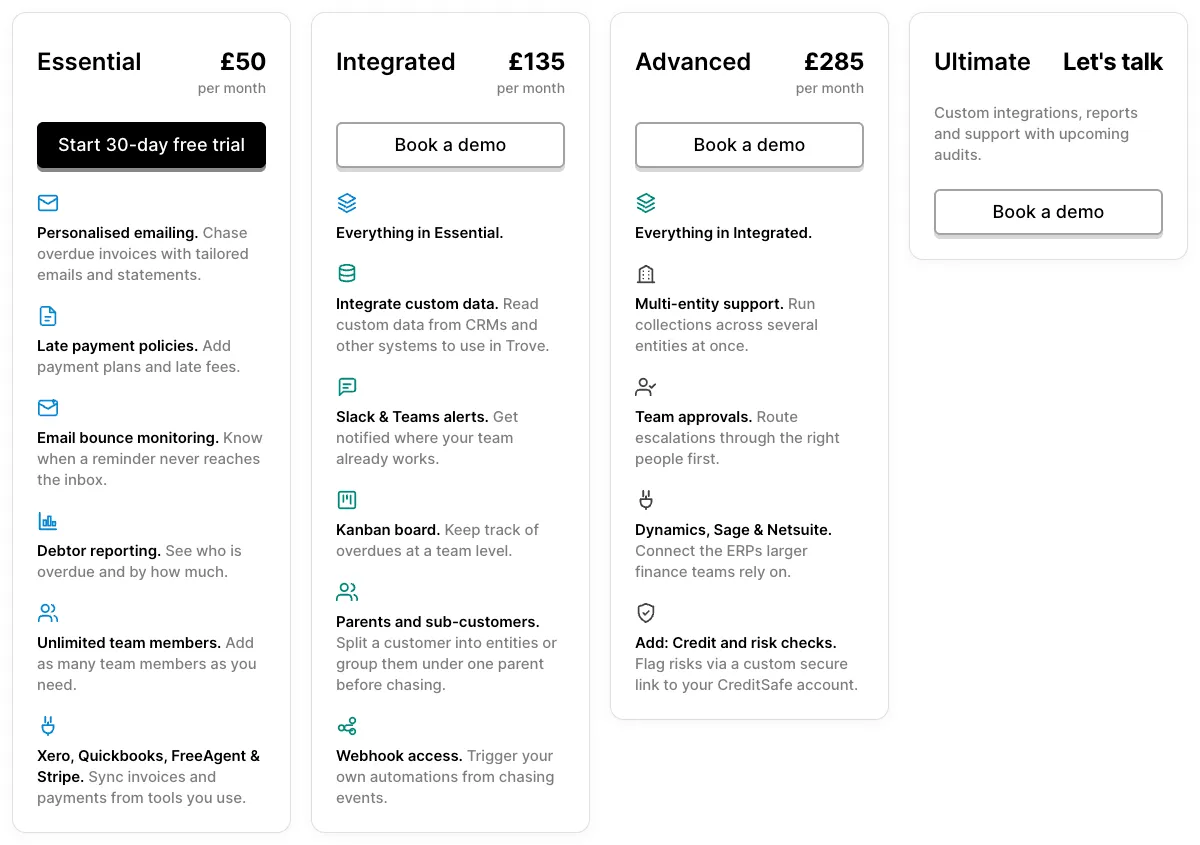 Trove pricing as of September 2026. Source: trove.works/pricing
All packages are billed monthly and you can cancel anytime. Essential and Integrated start with a 30-day free trial, and Advanced starts with a demo.
Stripe sync is included on every Trove plan. See how it works for chasing Stripe invoices.
Parent and sub-customers, on Integrated and above, let you chase a group of related companies as one account, or split one Xero customer by department, site or project. See how parent customers work and how sub-customers work.
When size-based pricing is the better deal
Size-based pricing isn’t a trick and there are situations where it’s the right thing to buy. The main one is if the tool is absorbing work you would otherwise hire for.
If the features on the more expensive plans are replacing work done by a person, they may be worth it. Measured against a salary, £899 isn’t much.
How does Trove compare on price?
Starting prices only tell you so much. The better test is what each tool costs a business like yours. Take a £5 million turnover business with five people touching credit control:
| Chaser | Kolleno | Upflow | Trove | |
|---|---|---|---|---|
| Starting price | £199/month | £650/user/mo | ~$440/mo (unconfirmed) | £50/month |
| Pricing published? | Yes (base plans) | Per-user figures only | No | Yes |
| Pricing model | By turnover band | Per user | By ARR tier | Fixed packages |
| Free trial | 10 days | No | Free tier (analytics only) | 30 days |
| Target customer | UK SMBs to mid-market | Mid-market/enterprise finance teams | Scaling/enterprise B2B & SaaS | Small/mid-market B2B |
| Monthly cost for a £5m business, five users | £599 (Core, £4m-£10m band) | around £3,250 (5 x £650) | Not published | £50 to £285, depending on package |
| Users included | 4 on Compact, unlimited from Core | Priced per user | Not published | Unlimited on every package |
| Paid add-ons | SMS, auto-call, payment portal | Integrations and customisations | Not published | CreditSafe checks on Advanced |
| Cancel anytime? | Not published | Not published | Not published | Yes, monthly billing |
If you’re a SaaS business, Upflow’s ARR bands make more sense than they do for a services business. For everyone else, the difference comes down to whether you want your price tied to your size or to the features you use.
Free trials, demos and getting started
A free trial is the only way to know whether a tool fits how you chase. The four tools here handle it very differently:
- Trove: 30-day free trial on the Essential and Integrated packages, no card required. Set up takes about 15 minutes, and you can also start directly from the Xero, FreeAgent or Stripe app stores. Advanced starts with a demo.
- Chaser: 10-day free trial, no card required.
- Kolleno: no published trial. You go through a demo and a quote, and onboarding takes around 10 days.
- Upflow: a free tier limited to analytics. You can see your AR data but can’t automate chasing without a paid plan.
A 10-day trial only just covers one reminder cycle. To see whether customers pay faster, you need at least one full month of invoices going through the tool. We’ve put together a list of what to test during a credit control software free trial.
Start a free trial or book a demo if you’d like to see it first.
What the pricing tells you about each product
Pricing structure tends to reflect product philosophy, and these four tools sit a long way apart.
Chaser is built for small to mid-sized businesses that want predictable costs and a quick setup. Published pricing and turnover-based tiers suggest a product designed for business owners and lean finance teams, not procurement. The add-on model and the steep jumps between bands add complexity, but the base plan is accessible.
Kolleno is built for finance teams, not business owners. Per-user pricing, a sales-led process and a multi-day onboarding all point to a platform bought by mid-market and enterprise teams with a budget and an evaluation cycle. You’re paying for breadth and collaboration - invoicing, payments, reconciliation and collections in one place, designed for a team to run together.
Upflow is a different product for the software industry. ARR-based tiers, undisclosed pricing and a mandatory sales process point to a tool built for scaling tech companies that need a collections product to integrate into their stack. The AR analytics and workflow configurability go well beyond what most small businesses need or want to manage. For what B2B SaaS teams need after the retry window closes, pricing that scales with your revenue is only part of the picture.
Trove sits at the other end of the spectrum. Fixed packages, no per-user fees, and a self-serve trial mean you can be up and running in an afternoon without talking to anyone. It’s designed for businesses where one or two people handle collections and the goal is to spend less time on it, not more.
What to ask before you sign
Pricing pages rarely tell you what actually moves the number. These four questions do.
What happens to my price if turnover grows 30% but invoice volume doesn’t? This is the question that separates the models. If the answer is that the price rises, you’re paying for size rather than work.
Is “collected revenue” all my revenue, or only what the tool recovers? A meaningful difference on a percentage-based plan, and the wording on pricing pages is often ambiguous. Get it in writing.
Which features are add-ons? Chaser’s SMS reminders, auto-call and payment portal all sit outside the headline price. Build a full quote covering what you’ll actually use rather than comparing base plans.
What’s the minimum term, and what happens at renewal? Annual commitments are common, and a tool priced on a turnover band will reassess when you renew.
For how the tools differ on features and target customers, see our credit control software comparison. For the full breakdown on each vendor, see what Chaser costs, what Kolleno costs, what Upflow costs and what Credit Hound costs.
Frequently asked questions
How much does credit control software cost? Published prices run from about £50 a month for fixed-price tools like Trove to £650 per user per month for enterprise platforms like Kolleno. Chaser sits in between at £199 to £899 a month depending on turnover. Tools that don’t publish pricing, like Upflow, are usually priced by company size.
How much does Chaser cost? Chaser’s plans start at £199/month for businesses under £4 million turnover, then £599/month under £10 million and £899/month under £100 million. SMS, auto-call and the payment portal are paid add-ons. Our Chaser pricing guide has the full breakdown.
Is there a free trial for credit control software? Most tools offer one. Trove has a 30-day free trial with no card required, Chaser has 10 days, and Upflow has a free analytics-only tier. Kolleno doesn’t publish a trial.
What’s the most affordable credit control software? For statements only, Statey starts at £8/month. For automated chasing, Trove starts at £50/month fixed, with unlimited team members and no turnover limits. Satago starts at £45/month, but reminders are sent from Satago’s own address until the £80 plan.
What’s the best pricing model for a high-volume business? Usually a fixed fee, because your costs then track your feature needs rather than your turnover. The exception is a tool that absorbs enough work to replace a hire, in which case compare it against a salary rather than against other software.
Is fixed-price credit control software cheaper than percentage-based? Past a low threshold, almost always. On £5 million of collected revenue, 0.3% is £15,000 a year against £600 for a tool at £50/month. The two converge somewhere below £200,000 of collected revenue.
Why don’t some tools publish pricing? Usually because they price by negotiation against company size. It’s normal in enterprise software, but it makes budgeting harder, and it’s a fair thing to weigh when your margin is thin.
Do any credit control tools charge a percentage of what they collect? Some do. Lunos.ai publishes 0.3% of collected revenue, Upflow has historically billed as a percentage of revenue collected, and LedgerUp prices on billing volume. Most UK tools aimed at smaller businesses charge a fixed fee instead.
Trove is credit control software for small businesses. Fixed packages from £50/month, a 30-day free trial with no card required, and set up in about 15 minutes. Billed monthly, cancel anytime.