We looked at every expected payment date set by businesses using Trove to find out.
Key findings
- 7 in 10 promised payment dates are met, or missed by no more than three days.
- A missed date usually isn’t a lost payment. 83% of missed dates are paid within a month.
- Following up quickly leads to faster payment. When a missed date got a follow-up within three days, 76% were paid within a week. Without one, it was 49%.
Most customers pay if they give an expected payment date
Of the payment dates customers gave, 59% were met: the invoice was paid in full on or before the date. Another 11% were paid within three days of it. That’s 7 in 10 promised dates met, or close enough that it barely matters.
| What happened by the promised date | Share of promised dates |
|---|---|
| Paid on or before the date | 58.9% |
| Paid 1 to 3 days late | 11.1% |
| Paid 4 to 14 days late | 16.9% |
| Paid 15 or more days late, or still unpaid | 13.1% |
When a customer gives you a date, it’s usually worth believing them. Most mean it, and the ones who slip rarely slip far.
A missed date usually isn’t a lost payment
When a promised date passed without payment, 55% of those invoices were paid within a week, 68% within two weeks and 83% within a month. Only 8% were still at the time of writing.
A missed promise is far more often a delayed payment run, an approval stuck in someone’s inbox or a bank transfer nobody got round to than a customer who’s decided not to pay. That changes how you should respond to one.
Following up quickly gets missed payments in faster
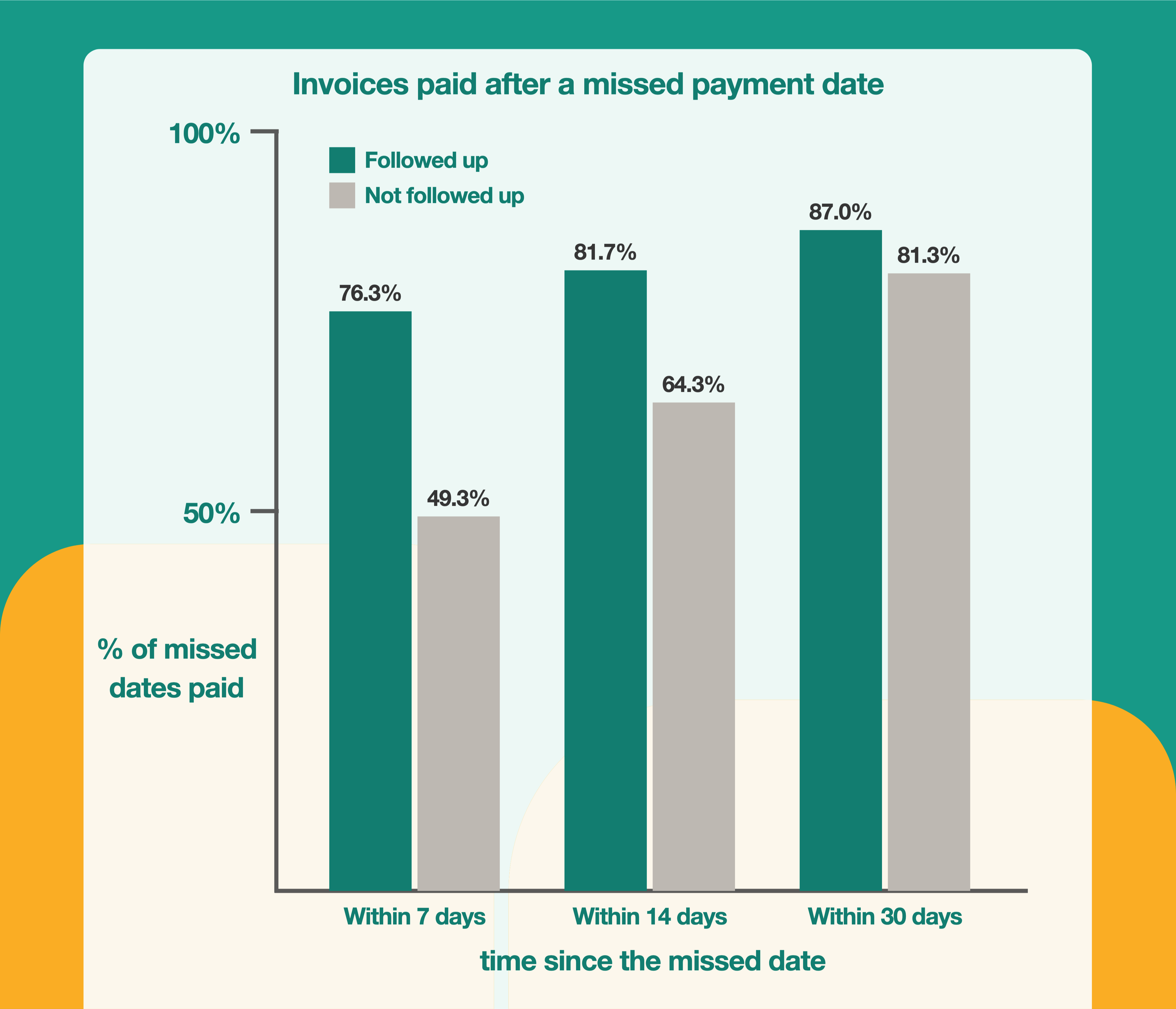
When a reminder went out within three days of a missed date, 76% of those invoices were paid within a week. Where no follow-up went out, it was 49%.
The gap narrows over time. By 30 days it’s 87% against 81%, because most late payers get there eventually. The bigger difference is what’s left at the end: only 2% of followed-up missed dates were still unpaid by mid-October, against 10% of the rest.
This shows what happened, not why. Businesses that follow up quickly may also have customers who pay faster anyway, and the follow-up group is small, with a large share of it coming from one business. We’ll keep tracking this as more data comes in.
What this means for your credit control
Ask for a date in writing
A date in an email is easy to hold someone to and easy to refer back to. If a customer replies to a reminder without giving one, ask: “When can we expect payment?” is enough.
Record it against the invoice
Put the date somewhere you’ll see it pass, not in your head. Xero has an expected payment date field on each invoice for exactly this.
Follow up the day after it passes
Keep it short and friendly: “Just checking the payment we discussed for Friday has gone through.” Most missed dates are an oversight, and a quick nudge while it’s fresh gets the money in sooner.
Don’t escalate too early
Most late payers get there within a fortnight. Save firmer steps, like a letter before action, for invoices still unpaid weeks after the promised date.
Trove does the last three steps for you. It picks up payment dates from your customers’ replies, sets them as the expected payment date on the invoice, and follows up automatically if the date passes without payment. If you’d like to see it working on your own customers’ replies, you can start a free 30-day trial here or book a demo first.
For what happens before a customer gives you a date, here’s our data on how many reminders it takes to get invoices paid.
The full numbers
What happened by the promised date
| Outcome | Share of promised dates |
|---|---|
| Paid on or before the date | 58.9% |
| Paid 1 to 3 days late | 11.1% |
| Paid 4 to 14 days late | 16.9% |
| Paid 15 or more days late, or still unpaid | 13.1% |
What happened after a missed date
| Paid within 7 days | Paid within 14 days | Paid within 30 days | Still unpaid | |
|---|---|---|---|---|
| All missed dates | 55.1% | 68.1% | 82.6% | 8.0% |
| Followed up within 3 days | 76.3% | 81.7% | 87.0% | 1.5% |
| No follow-up within 3 days | 49.3% | 64.3% | 81.3% | 9.8% |
- Promised dates: every expected payment date on an invoice belonging to a business using Trove, set after the business started using Trove, and falling between July 2025 and mid-September 2026. Payments were checked up to 14 October 2026.
- What counts as a promised date: the expected payment date on the invoice, whether picked up from a customer’s reply, typed in by the business or synced from their accounting software.
- Met: the invoice was paid in full on or before the date. Part-payments count as not met.
- Follow-up: a chasing email, SMS or phone call reminder sent through Trove in the three days after the date passed.
- Left out: voided invoices, and dates set before the business started using Trove.
- Only the latest date on each invoice counts. If a date was moved, we see the new one and not the original, so the share of dates met may be slightly flattering.
Each business’s figures are combined, and no single business makes up more than about a fifth of the promised dates.