
Summary
- The expected payment date is the day you now realistically expect an invoice to be paid, as opposed to the due date it was contractually owed.
- Keeping it current does two jobs: it keeps your forecast honest and it stops you chasing customers who have already told you when they’ll pay.
- Maintaining it in Xero is completely manual so you have to stay on top of customer communications if you want it to be useful.
- Trove updates the expected payment date in Xero straight from your customers’ email replies, pauses chasing until the date passes, and resumes if the money doesn’t land.
What is Xero’s expected payment date feature
Every invoice in Xero has a due date: the day payment was contractually due. The expected payment date tells you when the money is expected, based on what the customer has actually told you.
Say you invoice a customer on 30-day terms and the invoice falls due on the 1st. You send them a reminder and they say it will be paid on their next payment run on the 7th.
You now have two pieces of data:
Due date: 1st of the month
Expected payment date: 7th of the month
Most businesses track both for different reasons.
Why it’s important to keep track of expected payment date
There are two reasons the expected payment date is worth getting right.
- Cash flow forecast. Your cash flow forecast is only as accurate as your expected payment date. If an invoice is due on the 1st but the customer has confirmed payment for the 7th, you need to show the cash as landing on the 7th. Otherwise the forecast is made up of fake data.
- It stops unnecessary chasing. Few things annoy a customer more than another reminder when a payment date has been agreed. Avoid this by recording the expected payment date. Then everyone chasing that account can see the promise and hold off until it passes.
Keep the dates honest and the whole process gets calmer: a forecast you can trust and no reminders going out to people who’ve already told you when they’ll pay.
How to update expected payment date in Xero
In Xero, you set and edit expected payment dates from the Awaiting Payment tab of your sales invoices (Sales > Invoices > Awaiting payment). From the table, you can enter an expected payment date directly into the Expected Date field:
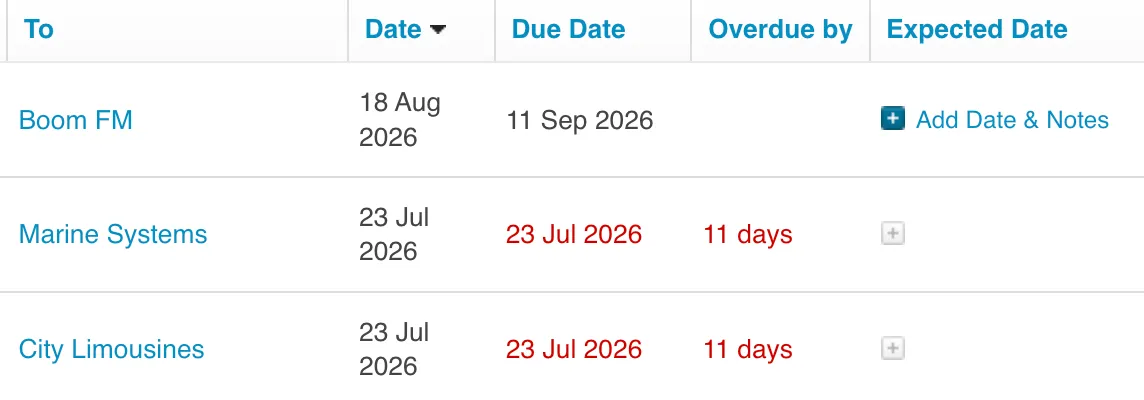
This works but will always be a manual step. If a customer gives you a new date, someone has to go back into Awaiting Payment and edit it by hand.
Trove updates expected payment date directly from your email
When you chase an invoice through Trove and the customer replies with a new date, Trove runs a process each time:
- It reads the reply and updates the expected payment date against the invoice in Xero for you.
- Then it pauses further chasing until that payment date arrives.
- It can also draft an email to the customer for you to send, thanking them.
- If the date passes and the money hasn’t landed, Trove picks chasing back up automatically.
This avoids expected payment dates going stale or getting lost somewhere in your email. We’ve written a full guide to updating Xero’s expected payment date directly from your email. If you already use Trove, our support doc covers exactly how expected payment dates sync with Xero.
Using expected payment date to forecast cash flow
Once your expected payment dates are current, they become a live picture of when money is actually due to arrive, customer by customer. That’s the difference between a forecast built on due dates (which customers routinely miss) and one built on what they’ve actually promised.
Here’s how to use Xero’s expected payment date to forecast when you’ll receive payment.
The takeaway
Xero’s expected payment date is one of the more useful fields in your ledger and one of the most neglected because keeping it current is manual work that never reaches the top of the pile.
If updating it by hand is the part that never happens, that’s exactly the job Trove takes off you.
Make your expected payment dates into useful data with Trove
Trove reads your customers' replies, updates the expected payment date in Xero, and chases what's still outstanding, all from your own email.