Summary
- Trove is credit control software for growing UK finance teams. On Trove’s Advanced plan, group reports show overdue debt across every entity, converted into one currency.
- A monthly debtors pack needs five tables: total and overdue debt by entity, aged debt by entity, the top overdue customers, promised payments due in the next 30 days, and disputes and at-risk accounts.
- Every table in a debtors pack should show each entity and the group total in one reporting currency.
- Convert both months at the same exchange rate when you compare overdue debt month on month, so currency moves don’t look like collection performance.
- Each table answers a question a CFO asks: is overdue going up, what’s stuck, who owns the problem, what cash is coming and what could be lost.
- A debtors meeting with this pack takes about 30 minutes, with actions carried into next month’s pack.
The five tables in a monthly debtors pack
Each table answers one question. If a table doesn’t change a decision, drop it.
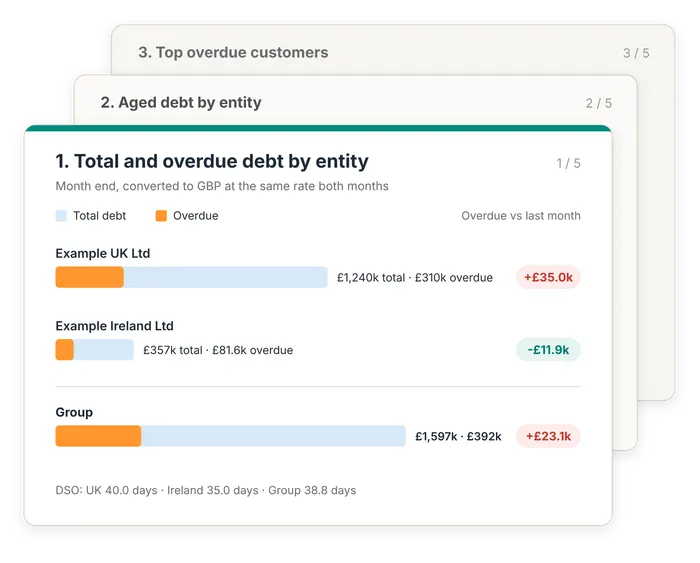
1. Total and overdue debt by entity, with the change on last month
What’s owed, how much of it is overdue, and whether that’s better or worse than last month. Add days sales outstanding (DSO) here if your CFO tracks it.
The CFO wants this first because it’s the headline. One number per entity, and the direction it’s moving, tells them where to look in the rest of the pack.
2. Aged debt by entity
Overdue debt split into age bands: 1 to 30 days, 31 to 60, 61 to 90 and over 90. Most teams also show “not yet due” so the total ties back to table 1.
Age matters because old debt is harder to collect. A rising 61 to 90 band this month is next month’s 90+ problem. If you want a refresher on reading the bands, our guide to the Xero aged receivables report explains them.
3. Top overdue customers, with owner and next action
The ten or so customers who make up most of the overdue balance, with the entity, amount, oldest invoice, who’s chasing and what happens next.
This is the table the meeting spends most time on. A name and a next action turn “we’re owed a lot by Northgate” into “Priya follows up on 7 November if the promised payment hasn’t landed”.
4. Promised payments due in the next 30 days
Every payment a customer has promised, with the amount and date, grouped by entity. This is the closest thing the pack has to a cash forecast.
On a recent demo call, a finance lead running four regional entities said this was the gap that mattered most: they wanted promised dates captured every time, so the cash forecast for the CFO was right to the penny. In practice, small promises often go unrecorded because logging them takes too long.
5. Disputes and at-risk accounts
Disputed amounts with the reason and who’s resolving them, plus customers whose payment behaviour is getting worse.
The CFO wants this because it’s the money most likely to be written off, credited or provided for. It’s also where sales usually needs to be involved.
Worked example: a monthly debtors pack across two entities
Here’s the pack filled in for a group with two companies: Example UK Ltd, which invoices in sterling, and Example Ireland Ltd, which invoices in euros.
Euro balances are converted at an illustrative €1 = £0.85. Both months are converted at the same rate, so the change on last month reflects collections, not currency.
Table 1: total and overdue debt by entity
| Entity | Total debt | Overdue | Overdue last month | Change | DSO (days) |
|---|---|---|---|---|---|
| Example UK Ltd | £1,240,000 | £310,000 | £275,000 | +£35,000 | 40.0 (last month 37.2) |
| Example Ireland Ltd (€420,000 total, €96,000 overdue) | £357,000 | £81,600 | £93,500 | -£11,900 | 35.0 (last month 36.1) |
| Group | £1,597,000 | £391,600 | £368,500 | +£23,100 | 38.8 (last month 37.0) |
DSO here is total debt divided by average daily credit sales, as the Association of Corporate Treasurers defines it. This example uses the last 90 days of sales, which were £2,790,000 in the UK and €1,080,000 (£918,000) in Ireland.
The group number hides the story. Overdue is up £23,100, but Ireland improved. The whole increase, and more, is in the UK.
Table 2: aged debt by entity
| Entity | Not yet due | 1 to 30 days | 31 to 60 days | 61 to 90 days | Over 90 days | Total |
|---|---|---|---|---|---|---|
| Example UK Ltd | £930,000 | £168,000 | £82,000 | £36,000 | £24,000 | £1,240,000 |
| Example Ireland Ltd | £275,400 (€324,000) | £44,200 (€52,000) | £20,400 (€24,000) | £10,200 (€12,000) | £6,800 (€8,000) | £357,000 (€420,000) |
| Group | £1,205,400 | £212,200 | £102,400 | £46,200 | £30,800 | £1,597,000 |
Table 3: top overdue customers
| Customer | Entity | Overdue | Oldest invoice | Owner | Next action |
|---|---|---|---|---|---|
| Northgate Retail Group | UK | £64,000 | 38 days | Priya | Promised 6 Nov. Follow up 7 Nov if not paid |
| Harbour Foods | UK | £41,500 | 72 days | Sam | £9,800 disputed on price. Account manager to agree credit note by 6 Nov |
| Liffey Distribution | Ireland | £25,500 (€30,000) | 45 days | Aoife | In their 15 Nov payment run |
| Brightwell Leisure | UK | £22,800 | 96 days | Sam | No reply to four reminders. Letter before action this week |
| Coastline Hotels | Ireland | £15,300 (€18,000) | 31 days | Aoife | New accounts contact found. Invoices re-sent |
These five customers are £169,100, or 43% of the group’s overdue debt. A short list with owners is more useful to a CFO than a long list without them.
Table 4: promised payments due in the next 30 days
| Entity | Customer | Promised date | Amount |
|---|---|---|---|
| Example UK Ltd | Northgate Retail Group | 6 Nov | £64,000 |
| Example UK Ltd | Kestrel Engineering | 13 Nov | £12,400 |
| UK subtotal | £76,400 | ||
| Example Ireland Ltd | Liffey Distribution | 15 Nov | £25,500 (€30,000) |
| Example Ireland Ltd | Coastline Hotels | 20 Nov | £8,500 (€10,000) |
| Ireland subtotal | £34,000 (€40,000) | ||
| Group | £110,400 |
How much should the CFO trust this number? Trove’s data shows 7 in 10 promised payment dates are met, or missed by no more than three days. Promises are worth tracking, but present the total as expected cash, not banked cash.
Table 5: disputes and at-risk accounts
| Customer | Entity | Amount | Type | Reason | Who's resolving it |
|---|---|---|---|---|---|
| Harbour Foods | UK | £9,800 | Dispute | Price on two invoices doesn't match the agreed rate | Account manager |
| Coastline Hotels | Ireland | £3,400 (€4,000) | Dispute | Missing purchase order number | Aoife |
| Brightwell Leisure | UK | £22,800 | At risk | Average time to pay up from 34 to 58 days over three months, no replies | Sam, with the CFO's sign-off on next steps |
| Group | £36,000 | £13,200 disputed, £22,800 at risk |
The questions your CFO will ask, and where each answer sits
A good pack answers the CFO’s questions before they’re asked. These are the ones that come up most, and the table that answers each.
| The CFO asks | Where the answer is | In the example |
|---|---|---|
| Is overdue debt going up or down, and where? | Table 1 | Up £23,100 for the group, all of it in the UK |
| Is DSO getting worse? | Table 1 | Group DSO up from 37.0 to 38.8 days, driven by the UK |
| What's stuck, and how old is it? | Table 2 | £30,800 over 90 days, £24,000 of it in the UK |
| Who are the biggest movers, and who owns them? | Table 3 | Five customers hold 43% of overdue debt, each with an owner |
| How much cash comes in next month? | Table 4 | £110,400 promised in the next 30 days |
| What could we lose? | Table 5 | £36,000 disputed or at risk |
If the CFO asks a question the pack can’t answer, add it to next month’s pack. After two or three months the pack fits the business.
How to run a 30-minute debtors meeting
The pack does the reporting. The meeting is for decisions.
- Group view (5 minutes). Table 1. Agree whether the month was better or worse, and which entity drove it.
- Last month’s actions (5 minutes). Did each one happen, and did the customer pay?
- Top overdue customers (10 minutes). Table 3. Confirm each owner and next action. Anything over 90 days gets a decision: keep chasing, escalate or hand to a debt collection agency.
- Disputes and at-risk accounts (5 minutes). Table 5. Agree who in sales or operations resolves each dispute, and by when.
- Cash outlook (5 minutes). Table 4. Flag promises that look shaky.
Write the actions down with a name and a date. They’re the first thing you review next month, which keeps the meeting honest.
Building the debtors pack without rebuilding Excel every month
Most teams build this pack in Excel from an aged receivables export, one entity at a time, then convert and combine. It works, but it takes a day each month and goes out of date the moment it’s sent. Our guide to credit control reports in Excel and Xero covers that route.
With Trove’s credit control reporting, most of the pack is live:
- Every plan includes saved reports on overdue invoices, debtor health and recently paid invoices. Debtor health shows which customers are new, getting worse or unchanged, which feeds table 5.
- On the Integrated plan, you can build your own reports, filtered by days overdue, customer, contact group, amount, due date, chase stage, owner or week-on-week change. That covers the age bands in table 2 and the owner view in table 3. Reports can also post to Slack or Teams.
- On the Advanced plan, group reports show overdue debt across every entity, with a breakdown by entity and balances converted into one currency. That’s table 1 without the spreadsheet. Multi-entity support lets each company keep its own currency and sender address under one login. Our guide to running credit control across multiple entities in Xero shows how that works day to day.
Reports can be emailed daily, weekly or monthly to people without a Trove or Xero login, so the CFO gets the pack on the morning of the meeting with a link to the live view.
Table 4 needs promised dates to be recorded in the first place. Trove’s AI reads customer replies, picks out promised dates and sets them as expected payment dates in your accounting software when you approve them, so the dates are there to report on. Here’s how that works with Xero’s expected payment date, and how it works in Business Central.
For the wider set of reports a group should run, see the credit control reports that matter when you run a group.
FAQs about the monthly debtors pack
What should be in an aged debtors report for the CFO?
Overdue debt split into age bands (1 to 30, 31 to 60, 61 to 90 and over 90 days) for each entity, with the group total and the change on last month. Pair it with the top overdue customers, promised payments, and disputes, so the CFO sees causes as well as totals.
How do you report debtors across several companies?
Show every table by entity with a group total, converted into one reporting currency. Use the same exchange rate for this month and last month when you compare them, so currency movements don’t look like collection performance.
How often should you hold a debtors meeting?
Monthly works for most groups, timed just after month end so the figures are final. Teams with a lot of debt over 60 days often add a short weekly check on the top overdue customers.
Should the debtors pack include DSO?
Yes, if the CFO tracks it, shown per entity and for the group with last month alongside. DSO moves slowly, so the trend over three to six months matters more than one month’s change.
Trove runs a free 30-day trial. You can start a free trial here or book a demo if you’d like to see group reporting with your own entities first.