

Summary
- Trove is credit control software for growing UK finance teams. Its Kanban board gives each disputed account an owner and its own column, and its AI Reply Agent reads remittance advice from emails and PDFs.
- A supermarket deduction is money a retailer takes off a payment for promotions, logistics charges, shortages, pricing differences or penalties, so the remittance pays less than the invoice.
- To find deductions, match every remittance line to the invoice it pays. Any line paid short is a deduction until you know otherwise.
- To dispute one, sort it by type, check it against the supply agreement and the evidence (proof of delivery, the promotion agreement, the agreed price), then raise it with the retailer within its deadline.
- Under the Groceries Supply Code of Practice, the 14 designated retailers must pay suppliers in line with the supply agreement and can’t vary that agreement retrospectively.
- A deduction nobody checks is written off by default. Retailers don’t refund what nobody disputes.
The common types of supermarket deduction
Most deductions fall into five groups. The type tells you what evidence to pull and how likely the deduction is to stand.
These aren’t hypothetical. The GCA’s 2016 investigation into Tesco found deductions for short deliveries and missed service levels, promotional “gate fees” for activity that never happened, uncorrected pricing errors and historic claims suppliers hadn’t agreed to.
| Type | What it's for | Evidence you need | Valid or disputable? |
|---|---|---|---|
| Promotional funding | Your agreed contribution to a price promotion, multibuy or feature space | The signed promotion agreement, with dates, rate and volumes | Valid if it matches what you agreed in writing. Disputable if the rate, dates or volumes differ, or nothing was agreed |
| Logistics and shortage | Goods the retailer says didn't arrive, arrived damaged, or arrived outside the booked slot | Signed proof of delivery (POD), delivery booking, goods-received record | Disputable if your POD shows the full quantity signed for in good condition |
| Pricing differences | The retailer paid its system price rather than your invoice price | The agreed cost price and the date it took effect | Disputable if your invoice used the agreed price. Often a data error on one side |
| Compliance or penalty charges | Fines for late delivery, labelling, service level or paperwork failures | The clause in the supply agreement that allows the charge, and your delivery records | Disputable if the agreement doesn't provide for it, or your records show you met the standard |
| Unexplained | A short payment with no reason code, or a code nobody recognises | The remittance, the invoice and a written request for the reason | Disputable until the retailer explains it |
The takeaway: a deduction is only valid if something you agreed in writing supports it. Everything else is worth a question.
How to find supermarket deductions on a remittance
You find deductions by matching remittance lines to invoices, not by watching the bank balance. A big retailer pays dozens of invoices in one transfer, so a £540 shortfall disappears inside a £60,000 payment.
- Collect every remittance. They arrive by email, as PDF attachments or in the retailer’s supplier portal. Keep them in one place, by retailer and payment date.
- Match each line to an invoice. For every invoice on the remittance, compare the amount paid with the amount invoiced.
- Flag every line paid short. Note the invoice, the amount missing and any reason code the retailer gives.
- Check for invoices missing from the remittance. An invoice that should have been paid but isn’t listed is a different problem: it’s usually on hold, often for a missing PO. Here’s how to get the PO number before the invoice is due.
- Log each deduction as an open item. Give it an owner, a type and a date to resolve it by.
The cost of letting deductions sit is simple. Evidence gets harder to find, deadlines pass and the money stays with the retailer. If you run a monthly debtors meeting, deductions in dispute belong in the disputes and at-risk accounts table of the debtors pack.
How to check and dispute a supermarket deduction
Check the deduction against what you agreed before you contact anyone. A dispute with the evidence attached gets resolved. A dispute that says “we don’t recognise this” gets a request for evidence and another month’s delay.
- Read the supply agreement and any promotion agreements. Find the clause or agreement that would allow this deduction. If there isn’t one, say so in the dispute.
- Pull the evidence for the type. PODs for shortages, the promotion agreement for promotional funding, the agreed cost price for pricing differences.
- Check the retailer’s deadline. Retailers set their own windows for raising a dispute in the supply agreement or supplier manual. Raise it well inside that window.
- Send it to the right team. Questions about promotions and commercial terms usually go to the buyer. Shortages, pricing errors and unexplained deductions usually go to accounts payable or the retailer’s supplier support team.
- Put everything in writing. Quote the invoice number, remittance date, deduction amount and reason code, and attach the evidence.
- Escalate if nothing moves. Go to the senior finance contact named by the retailer, then to the Groceries Code Adjudicator’s guidance if you think the Code has been breached.
Keep the disputed amount separate from the rest of the invoice. Chase the undisputed balance as normal, and track the dispute as its own item until the retailer pays it back or you agree to write it off.
What GSCOP says about payments and deductions
The Groceries Supply Code of Practice (GSCOP) sets rules for how the largest UK grocery retailers deal with their direct suppliers. It’s enforced by the Groceries Code Adjudicator (GCA). This is a summary, not legal advice.
Who it covers. The Code applies to designated retailers with UK groceries turnover over £1 billion. The government’s April 2026 statutory review of the GCA lists 14: Aldi, Amazon, Asda, B&M, Co-op, Iceland, Sainsbury’s, Lidl, Marks and Spencer, Ocado, Tesco, Home Bargains (TJ Morris), Waitrose and Morrisons.
What the Code says about payments. In the Code itself:
- A retailer must pay for groceries delivered to its specification, in line with the supply agreement, and within a reasonable time after the date of the invoice (paragraph 5).
- A retailer must not vary a supply agreement retrospectively, unless the agreement clearly sets out when and how an adjustment is made (paragraph 3).
- A supply agreement must not make you pay the retailer for shrinkage (paragraph 7), and a retailer can’t make you pay for wastage unless it’s caused by your negligence or default, or the agreement sets out the basis for it (paragraph 8).
- A retailer must not make you predominantly fund a promotion, and must give reasonable written notice before a promotion you pay towards (paragraph 13).
What the GCA has said about deductions. The GCA’s best practice statement on forensic auditing says retailers shouldn’t treat a supplier’s silence as consent to a proposed deduction. Under the retailers’ voluntary commitment it refers to, audit claims are limited to the current financial year and the two before it.
In its 2016 investigation, the GCA found that Tesco had made unilateral deductions and delayed payments to suppliers. Its recommendations to Tesco included that Tesco shouldn’t deduct a disputed sum while the supplier is challenging it, and that Tesco suppliers get 30 days to challenge any proposed deduction. That was a recommendation to Tesco, not a rule for every retailer, so check your own agreement for the window that applies to you.
What the GCA does now. The GCA can give advice, arbitrate disputes, investigate suspected breaches and fine a retailer up to 1% of turnover. The 2026 review found that delay in payments was the issue suppliers reported most between 2022 and 2025, and that responsibility for the GCA is moving to Defra.
Worked example: one remittance with three deductions
Example Foods Ltd supplies chilled desserts to Example Grocers plc, a designated retailer. Priya runs credit control at Example Foods. On 2 October she receives a remittance for invoice EF-1041, for £18,400, which pays £16,212.
| Line | Retailer's reason | Amount | Evidence Priya pulls | Outcome |
|---|---|---|---|---|
| Invoice EF-1041 | - | £18,400.00 | - | - |
| Deduction 1 | Promotional funding, "2 for £5", weeks 36 to 38 | -£1,380.00 | Signed promotion agreement: £1,380 for weeks 36 to 38 | Valid. Matched to the promotion accrual and closed |
| Deduction 2 | Shortage, 30 cases not received | -£540.00 | POD signed at the depot for the full 600 cases, no exceptions noted | Disputed with accounts payable. Repaid on the next remittance |
| Deduction 3 | Code "ADM", no description | -£268.00 | Supply agreement has no admin charge. Written request for the reason | Disputed with the buyer. Retailer confirmed a system error and reversed it |
| Paid | £16,212.00 |
Priya logs the two disputed lines as open items the day the remittance arrives. She sends the shortage dispute to accounts payable with the signed POD attached, and the “ADM” query to the buyer with a request for the clause that allows it. She chases only the £808 in dispute, not the £1,380 she agreed to.
Five weeks later, both disputed amounts come back on the next remittance. Without the match, all £2,188 would have looked like an ordinary payment, and £808 of it would have stayed with the retailer.
Tracking supermarket deduction disputes as a team
Disputes get lost when they live in one person’s inbox. On a demo call this autumn, the AR lead at a UK confectionery brand selling to big retailers told us that the last credit control tool she’d looked at had no way to handle disputes, so they stayed in email alongside the remittances.
Three habits keep disputes moving:
- An owner for every dispute. One named person chases it to a result.
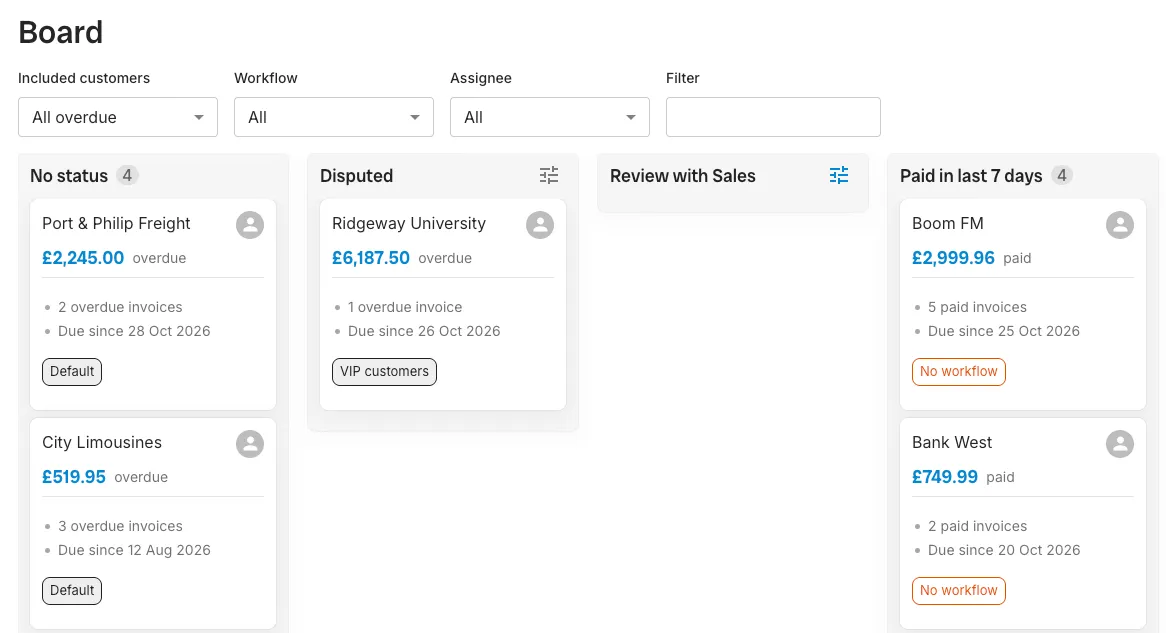
- A place everyone can see. A shared list or board, with disputed accounts in their own column, so nobody chases a customer who is waiting on you for evidence.
- The undisputed balance still gets chased. A dispute on one line isn’t a reason to stop collecting the rest.
Trove’s Kanban board puts your overdue accounts on a shared board synced with your accounting system. You set your own columns, such as “Disputed”, give each account an owner and keep notes with the account, so whoever picks it up sees what’s already been said.
When remittance advice arrives by email, Trove’s AI Reply Agent reads it from the email body or an attached PDF and picks out which invoices are being paid. Trove doesn’t detect or dispute deductions for you. It keeps the paperwork and the follow-up in one place.
If your bigger customers also make you invoice through a portal, here’s how to automate invoice uploads to Coupa and SAP Ariba. Before you take on a new retailer, it’s worth checking how a big customer pays before you sign.
FAQs about supermarket deductions
Can a supermarket deduct money from my invoice?
Only where your supply agreement allows it. Under GSCOP, a designated retailer must pay in line with the supply agreement and can’t vary it retrospectively, so a deduction with no basis in what you agreed can be disputed.
How long do I have to dispute a supermarket deduction?
It depends on the retailer. Each sets its own window in the supply agreement or supplier manual. After its 2016 investigation, the GCA recommended that Tesco give suppliers 30 days to challenge a proposed deduction, but that isn’t a rule for every retailer.
What is a short payment?
A short payment is when a customer pays less than the invoice total, usually because it has taken a deduction. The remittance should say which invoice was paid short and why. If it doesn’t, ask in writing.
Who do I contact to dispute a deduction?
Commercial deductions, such as promotional funding, usually go to the buyer. Shortages, pricing errors and unexplained codes usually go to accounts payable or supplier support. Include the invoice number, remittance date, amount and your evidence.
Can Trove track supermarket deduction disputes?
Yes. You can move a disputed account into its own column on Trove’s board, give it an owner and keep the notes with it. Read more about how Trove’s Kanban board works.
Trove runs a free 30-day trial. You can start a free trial here or book a demo if you’d like to see the board with your own retailers first.