

Summary
- Trove is credit control software for growing UK finance teams. For food and drink suppliers, it gives every retailer and wholesaler account an owner on a shared board, reads remittance advice from emails and PDFs, and groups many-site customers under one parent account.
- Chasing a big retailer is mostly matching and resolving, rather than reminding. Supermarkets pay on their own payment runs and take deductions before they pay, so a reminder rarely moves the money. Finding out what was paid short, and why, does.
- A supplier’s credit control against big retailers comes down to four jobs: reading remittances and matching payments, resolving deductions and short payments, chasing the right contact at a group with many sites, and protecting your cover if your receivables are insured.
- Sales and finance each own part of getting a retailer to pay. The account manager owns the relationship with the retailer’s buyer. The credit controller owns the ledger, the remittances and the evidence.
- Trove has a feature for each job: the AI Reply Agent for remittances, the Kanban board for disputed deductions, parent customers for many-site groups, and Creditsafe checks and Slack or Teams alerts for credit limits and insured accounts.
Why chasing a supermarket is different
A supermarket doesn’t pay because you sent a reminder. It pays when an invoice is in its system, matched to a purchase order, approved and picked up by the next payment run. Whatever doesn’t make that run waits for the next one.
Four things set supermarket credit control apart from chasing an ordinary trade customer:
- Payment runs. The retailer pays dozens of your invoices in one transfer on its own schedule. A chaser sent the day after a run has missed it.
- Remittances. The remittance advice, not the bank line, tells you which invoices were paid. It arrives by email, as a PDF or in the retailer’s supplier portal.
- Deductions. Retailers take money off payments for promotions, shortages, pricing differences and charges, so the amount paid is often less than the invoice.
- Concentration. A few big customers hold most of your debt. One stuck remittance from one retailer can be a big share of your month’s cash.
On a demo call this autumn, the finance team at a confectionery brand selling to UK retailers described exactly this. Their accounts receivable team covers four regions on Business Central, and handling disputes with retailers was one of the first things they asked about. At the third reminder, they message the customer’s account manager manually, and they wanted that hand-off built into the process.
The takeaway: the work is in the paperwork around the payment. Build your process around remittances, deductions and contacts first, and reminders second.
Reading remittances and matching payments
Match every remittance line to the invoice it pays, the day the remittance arrives. That’s how you find what was paid short, what’s missing and what was paid twice.
- Keep every remittance in one place, by retailer and payment date, whether it came by email, PDF or portal.
- Match each line to an invoice. Compare the amount paid with the amount invoiced.
- Flag every short line with the amount missing and any reason code.
- List the invoices that should have been paid but weren’t on the remittance. These are usually on hold, often for a missing or wrong PO. Here’s how to get the PO number before the invoice is due.
- Pass anything short or missing on as an open item with an owner and a date to resolve it by.
Retailer remittances often use their own references, such as a store or depot number, a PO number or a reason code, rather than your invoice number. Keep a short list of each retailer’s codes so the next match takes minutes instead of an afternoon.
Trove’s AI Reply Agent reads remittance details in the body of an email or in an attached PDF, and picks out which invoices are being paid and when. If your bigger customers also make you invoice through a portal, here’s how to automate invoice uploads to Coupa and SAP Ariba.
Deductions and short payments
Treat every short line as a deduction until you know what it’s for. Sort it by type, check it against your supply agreement, and either accept it or dispute it with evidence.
Most supermarket deductions are for promotional funding, logistics and shortages, pricing differences or compliance charges, with a few that come with no explanation at all. A deduction for a promotion you agreed in writing is valid. A shortage deduction where your signed proof of delivery shows the full quantity isn’t. The Groceries Supply Code of Practice sets rules for how the largest grocery retailers deal with their direct suppliers, including how they pay.
Two habits stop deductions turning into write-offs:
- Dispute the deduction, chase the rest. Keep the disputed amount separate and keep chasing the undisputed balance as normal.
- Send each dispute to the right team. Commercial deductions, such as promotional funding, usually go to the buyer. Shortages, pricing errors and unexplained codes usually go to accounts payable or supplier support.
We’ve written a full guide to finding and disputing supermarket deductions and short payments, with a table of deduction types, the evidence each one needs and a worked remittance.
Chasing a group with many sites
Chase whoever approves the invoice, and send the payment request to whoever pays it. At a wholesaler, a foodservice group or a chain with many depots, those are often different people.
Most groups need both: one statement to head office accounts payable, grouped by site, and a contact at each site for delivery queries. Give the whole group one owner on your side, so a depot manager and head office aren’t chased about the same invoice in the same week.
Time the statement before the group’s payment run. If head office pays on a fixed date each month, a statement a week before gives them time to approve everything that isn’t in query.
Here’s the full guide to chasing a customer group’s head office or each site. If several of the group’s companies sit in your ledger as separate customers, here’s how to chase one contact for several companies.
Credit insurance and credit limits
If your receivables are insured, your credit control process is also how you keep your cover. A trade credit insurance policy covers you up to an approved credit limit, and sets a deadline for telling the insurer about an account that’s overdue. Atradius says that deadline is typically 30 days after the maximum extension period.
Three steps keep you inside the policy:
- Check each big customer’s limit before you agree volumes. A new listing with a big retailer can take an account over its insured limit within weeks.
- Know each policy deadline in days overdue, and flag any account that’s getting close, so it’s reported in time.
- Keep the evidence of your chasing with the account. If you have to make a claim, the insurer will want to see what you did and when.
Your policy wording sets the actual limits and deadlines, so take the numbers from it, not from a rule of thumb.
Before you take on a new retailer or wholesaler, it’s worth checking how a big customer pays before you sign. Trove’s credit and risk checks flag each new customer that appears in your accounting system, so you can run a check straight away with your own Creditsafe account.
Who owns what: account managers, credit controllers and the retailer’s buyer
The credit controller runs the process. The account manager steps in where the retailer’s buyer has to act. Settling who does what before an invoice is overdue saves the week you’d otherwise lose working it out.
| Task | Owned by | When the other side gets involved |
|---|---|---|
| Matching remittances to invoices | Credit controller | Rarely. The account manager only hears about it if a line can't be explained without the buyer |
| Disputing a shortage or pricing deduction with accounts payable | Credit controller | When the evidence depends on something agreed with the buyer, such as a new cost price and its start date |
| Querying a promotional or other commercial deduction | Credit controller, who logs it with the evidence | When the query has to go to the buyer. The account manager raises it, because the buyer answers them |
| Getting a missing or wrong PO fixed | Credit controller, with the retailer's accounts payable team | When only the buyer can raise or correct the PO |
| Chasing head office before the payment run | Credit controller | Before a chaser escalates on a key account, so the account manager isn't caught out on their next call |
| Credit limits and reporting to the insurer | Credit controller or finance lead | Before orders are held or a limit is reached, so the account manager can manage the buyer's expectations |
| Agreeing trading terms and promotions | Account manager | When the terms change payment days or what the retailer can deduct, so finance can check them |
The retailer’s buyer takes calls from the account manager. The remittances, the proofs of delivery and the aged debt sit with the credit controller.
So make the hand-off a step in the process: when a query needs the buyer, the credit controller logs it against the account with the invoice number, the amount and the evidence, and asks the account manager to raise it. The account manager raises it on their next call and reports back on the account, and the credit controller keeps chasing the undisputed balance with accounts payable in the meantime.
Sales owns the relationship. Finance owns the ledger. Getting paid takes both.
Worked example: Example UK Ltd’s month with one supermarket and one wholesaler
Example UK Ltd makes chilled soups and sells to Example Grocers plc, a supermarket, and Example Wholesale Ltd, a wholesaler with nine depots. Hannah runs credit control. Tim is the account manager for Example Grocers.
| Date | What happens | Who acts | Result |
|---|---|---|---|
| 3 Nov | Example Grocers' remittance pays £42,600 against 14 invoices totalling £44,150 | Hannah matches every line the same day | Two lines short, £1,550 in total, and one invoice, £5,200, missing from the remittance |
| 3 Nov | £1,150 deducted for a "3 for 2" promotion | Hannah checks the signed promotion agreement | Valid. Matched and closed |
| 4 Nov | £400 deducted for a shortage of 25 cases | Hannah sends the signed proof of delivery to accounts payable | Repaid on the next remittance |
| 4 Nov | The £5,200 invoice is on hold: the PO on it has been closed | Hannah logs it and asks Tim to get the buyer to reissue the PO | Tim raises it on his call on 6 Nov. Hannah resubmits against the new PO |
| 18 Nov | Example Wholesale has £18,300 overdue across six depots. The Leeds depot has queried £640 for damaged goods | Hannah sends head office one statement grouped by depot, with the Leeds line marked "query open" | Head office approves £17,660 for its 25 Nov run |
| 20 Nov | A £3,900 Example Wholesale invoice nears the policy's deadline for reporting overdue accounts | Hannah tells the insurer before the deadline and notes it on the account | Cover kept while the invoice is chased |
By the end of the month, £400 of the £1,550 short-paid is back, £1,150 is closed as valid and the £5,200 invoice is in the next Example Grocers run. Without the matching on 3 November, the missing invoice and the shortage would both have looked like an ordinary payment until the next month’s aged debt report.
Nothing in Hannah’s month is a reminder schedule. Every step is a match, a dispute, a hand-off or a deadline, which is why the who-owns-what table matters more than the wording of your chasers. If you bring these items to a monthly meeting, put the disputed lines in the disputes and at-risk accounts table of a debtors pack.
Where Trove fits for food and drink suppliers
Trove sits between your ledger and the people who chase, so the credit controller and the account manager see the same accounts, owners and notes. It doesn’t detect or dispute deductions for you, and it doesn’t upload invoices to retailer portals. It keeps each job, and who owns it, in one place.
| Job | What Trove does | Plan |
|---|---|---|
| Reading remittances | The AI Reply Agent reads remittance details from the email body or an attached PDF and picks out which invoices are being paid and when | Every plan |
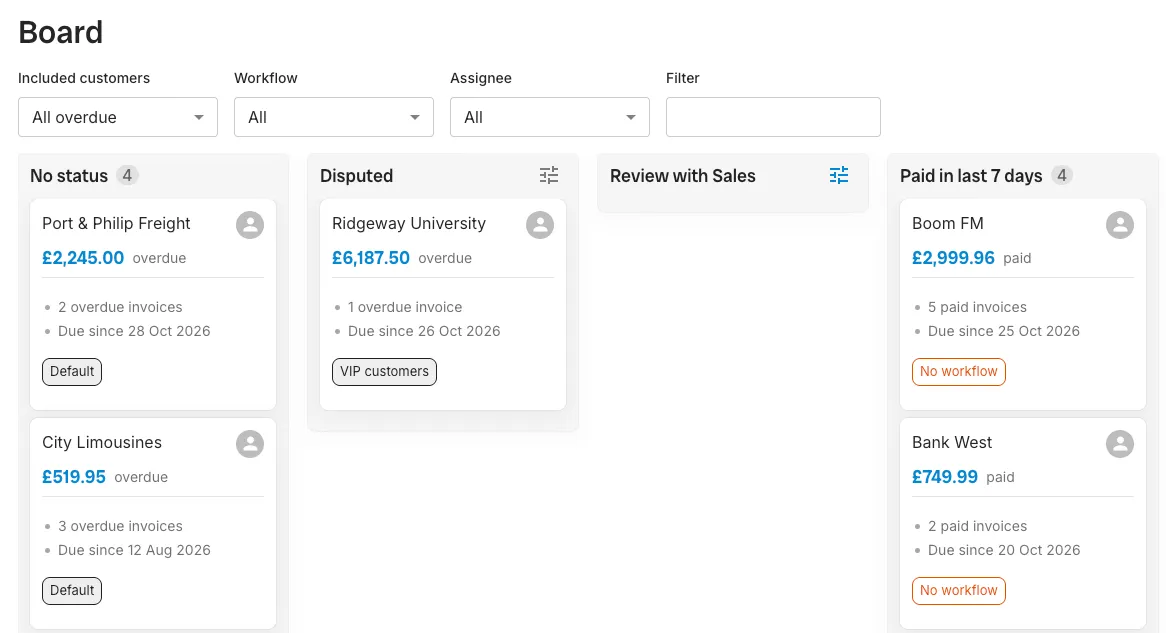
| Deductions and disputes | The Kanban board puts overdue accounts on a shared board, with your own columns such as "Disputed", an owner on every account and notes kept with it | Integrated and Advanced |
| Many-site groups | Parent customers group depots or companies into one account with one statement, and sub-customers split one account into sites with their own contacts | Integrated and Advanced |
| Credit limits and insured accounts | Credit and risk checks with your own Creditsafe account, and Slack and Teams alerts, such as when an invoice reaches 30 days overdue, sent to a shared channel or the account's owner | Checks: paid add-on on Advanced. Alerts: Integrated and Advanced |
| Hand-offs to the account manager | User roles and approvals let you give account managers view-only access, limit who can email customers and send anyone else's request to an approver, with every decision logged | Advanced |
| Your ledger | A two-way sync with Xero on every plan, and Business Central on Advanced | Xero: every plan. Business Central: Advanced |
Trove’s plans are Essential at £65 a month, Integrated at £140 and Advanced at £300, all with unlimited users. If you run Business Central, here’s how to chase overdue invoices in Business Central and how the credit control tools for Business Central compare.
FAQs about credit control for food and drink suppliers
How long do UK supermarkets take to pay suppliers?
It depends on your supply agreement with each retailer. To see what a retailer reports about its own payment times, search for its UK company on GOV.UK’s Check payment practices service, which publishes companies’ payment practice reports. We’ve put the latest figures for nine big supermarkets side by side.
Who should chase a supermarket, sales or finance?
Finance runs the chasing: matching remittances, disputing deductions and chasing accounts payable. The account manager steps in when something needs the retailer’s buyer, such as a commercial query or a PO only the buyer can fix. Read more about how Trove’s Kanban board gives every account an owner.
What is a short payment from a supermarket?
A short payment is when the retailer pays less than the invoice total, usually because it has taken a deduction. The remittance should say which invoice was paid short and why. Here’s how to find and dispute supermarket deductions.
How do I chase a wholesaler with many depots?
Send one statement, grouped by depot, to the head office contact who pays, and send delivery queries to a contact at each depot. Read more about how Trove’s parents and sub-customers work.
Does Trove work with Business Central?
Yes. Trove syncs with Business Central on the Advanced plan, and with Xero on every plan. It’s listed on Microsoft Marketplace. Read more about Trove’s ERP integrations.
Trove runs a free 30-day trial. You can start a free trial here or book a demo if you’d like to see your own retailers on the board first.