

Summary
- Trove is credit control software for growing UK finance teams. Its Kanban board can hold disputed accounts in their own column with an owner and notes, and its team approvals can send a reply to a named person, such as the account manager, before it goes to the customer.
- Log an invoice dispute the day it arrives, with the invoice, the amount in question, the customer’s own words and the type of dispute.
- Split the disputed amount from the undisputed balance and keep chasing the rest. A £600 price query on a £4,800 invoice leaves £4,200 that’s still due, plus any other overdue invoices on the account.
- Give every dispute one owner by type: pricing, delivery or quantity, quality, a missing PO or paperwork, or a duplicate. The type decides who can answer it.
- Let the person who owns the customer relationship agree the fix with the customer, then have finance raise and approve the credit note in the accounting system, within agreed limits, so the ledger stays right.
What counts as a dispute, and what’s just a query
A dispute is a customer saying they won’t pay some or all of an invoice until something is fixed. A query is a request for information that doesn’t change what’s owed. The difference matters because a query should be answered the same day and chased as normal, while a dispute needs an owner, a decision and sometimes a credit note.
| What the customer says | Query or dispute | Typical cause | Who can answer it |
|---|---|---|---|
| "Can you resend it with our PO number?" | Query | The PO wasn't on the invoice, so their accounts payable team can't match it | Credit controller, once the buyer gives the PO |
| "Can you send proof of delivery?" | Query | Their goods-received record is missing or late | Credit controller, with the signed POD from operations |
| "We think we paid this last month" | Query | A payment allocated to the wrong invoice, or a genuine duplicate | Credit controller, from the ledger |
| "That's not the price we agreed" | Dispute | A discount or new price agreed with the buyer that never reached the invoice | Account manager who agreed the price |
| "We only received 18 of the 20 cases" | Dispute | A short delivery, or a delivery the customer didn't book in | Operations or the warehouse, with the POD |
| "Half of it arrived damaged" | Dispute | Damage in transit or a quality fault | Account manager, with the quality or operations team |
A query that isn’t answered quickly turns into a dispute. Answer queries on the day and keep the invoice in your normal chasing.
Step 1: log it the day it arrives and split the disputed amount
The day a customer raises a dispute, write it down against the invoice and separate the amount in question from the amount that isn’t. Disputes arrive in a reply to a reminder, on a call with the account manager or in a note on a remittance. Wherever it lands, it goes in one place the whole team can see.
- Record five things. The invoice number, the amount in question, the customer’s words (copied, not paraphrased), the type of dispute and who raised it.
- Work out the undisputed balance. If £600 of a £4,800 invoice is in question, £4,200 isn’t.
- Tell the customer the rest is still due. Acknowledge the query, say who’s looking into it, and ask them to pay the undisputed amount in their next payment run.
- Offer a clean way to pay part of it. Some accounts payable systems can’t pay part of an invoice. If that’s the case, finance can credit the original and reissue it as two invoices: one for the undisputed amount and one for the amount in question.
- Keep chasing every other overdue invoice on the account. A dispute on one invoice isn’t a reason to stop collecting the others.
Step 2: give it one owner by type
Every dispute gets one owner, picked by its type. Finance keeps track of the dispute until it’s closed in the ledger. The owner is the person who can answer the question behind it, and their job is to come back to finance with a decision.
| Dispute type | Owner who answers it | What they need from finance | Answer back to finance within |
|---|---|---|---|
| Pricing | The account manager for the customer | The invoice, the quote or price list used, and the customer's words | 2 working days |
| Delivery or quantity | Operations or warehouse lead | The invoice, the delivery note and the quantity the customer says arrived | 2 working days |
| Quality or damage | The account manager, with the quality or operations team | Photos or a description from the customer, batch or delivery details | 5 working days |
| Missing PO or paperwork | Credit controller, working with the customer's buyer | The PO, contract or delivery paperwork the customer has asked for | 1 working day |
| Duplicate or already paid | Credit controller | The payment and remittance the customer is pointing to | 1 working day |
These times suit a business of about 100 people with one or two credit controllers and a sales team. Set your own, but write them down, so a dispute that’s gone quiet for a week is easy to spot. When a dispute sits with its owner past the date, it belongs in the disputes table of your monthly debtors pack.
Step 3: let the relationship owner agree the fix
The person the customer listens to should agree the fix, because a credit note is part of the commercial relationship as well as the ledger. In a pricing or quality dispute, the account manager usually knows what was promised to the buyer, and the credit controller knows what’s owed and what’s already been sent. So the account manager talks to the buyer, agrees the outcome (pay as invoiced, a credit, or a replacement) and tells finance what was agreed.
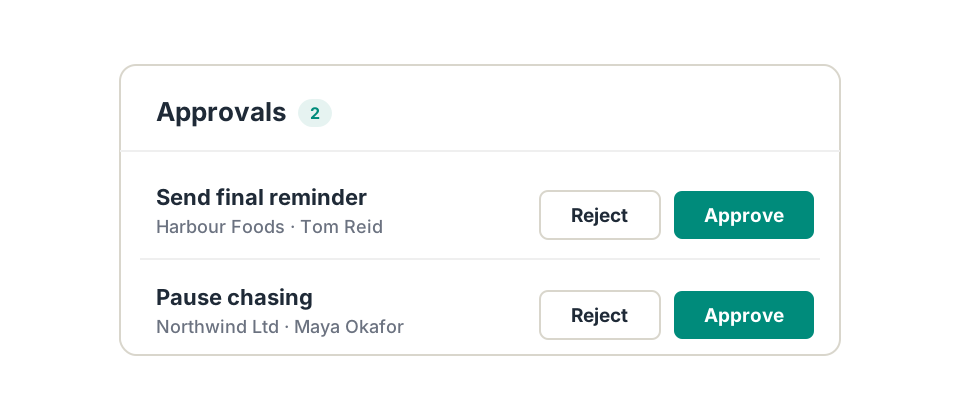
At Example UK Ltd, Tim, the account manager, agrees a £600 credit with the buyer by phone. Hannah, the credit controller, drafts the reply that confirms it, and Trove sends it to Tim to approve before it goes. Only once Tim has approved does Hannah raise the credit note, so the customer hears one answer and the ledger matches it.
Finance still runs the chasing. The account manager doesn’t take over the reminders or the other overdue invoices. They settle the question only they can settle, then hand it back. Here’s more on when to hand an overdue account to the account manager for reasons other than a dispute.
Step 4: finance raises the credit note and closes it in the ledger
Finance raises the credit note in the accounting system, allocates it to the invoice and records why. The account manager agrees the outcome with the customer, but the credit note itself is a ledger entry, and it needs the same checks as any other.
Agree limits by value, so nobody has to ask who can sign off a £3,000 credit while the customer waits.
| Credit note value | Who agrees it with the customer | Who approves it in finance |
|---|---|---|
| Up to £250 | Credit controller, after a check with the account manager | Credit controller |
| £250 to £2,500 | Account manager | Finance manager |
| Over £2,500 | Account manager, with their sales director | Finance director or CFO |
When the credit note is raised:
- Reference the original invoice and give the reason in the credit note’s description.
- Allocate it to the invoice straight away, so the customer’s balance shows what’s really owed.
- Send it to the customer with a line confirming the new balance and when you expect it to be paid.
- Record the type and the cause. If the same price list error causes three disputes in a quarter, the fix is the price list, not faster credit notes.
Step 5: pause and restart chasing on the right amount
Pause reminders on the disputed invoice while its owner works on the answer, set a review date, and keep chasing the customer’s other overdue invoices.
- What to pause. The disputed invoice only. Pausing the whole customer stops chasing on invoices nobody has questioned.
- How long for. Until the owner’s date from the table in step 2, or 5 working days, whichever comes first. If there’s no answer by then, finance follows up with the owner, not the customer.
- What happens to the undisputed amount. Ask for it in the meantime. If the customer can only pay whole invoices, get the credit note or the reissued invoice out quickly, because the undisputed amount waits for it.
- When to restart. As soon as the credit note is allocated, or the customer accepts the invoice as it stands. Restart on the corrected balance with a fresh follow-up date, usually 3 working days out.
If you use Xero, Business Central or Trove, here’s how to pause invoice reminders for one customer and make sure they start again.
Disputes with big retailers and groups
Big retailers and groups with many sites dispute in their own ways, and they each have a page of their own. A supermarket usually takes money off a payment as a deduction rather than raising a dispute first. Here’s how to find and dispute supermarket deductions and short payments, and how to read a supermarket remittance line by line.
A customer with many sites can query an invoice at one store while head office pays the rest. Here’s how to chase a customer group with many sites, including what to do with a queried store invoice. For the wider picture of selling to retailers, see credit control for food and drink suppliers. In recruitment, disputes tend to be about fees and rebates instead: here’s how to handle disputed perm fees and rebate clauses.
If you run several companies, the process is the same in each one. The credit controller for each entity owns the dispute log for their customers, and the limits in step 4 apply group-wide.
A worked example: a £4,800 invoice with a £600 price query
Example UK Ltd supplies Example Wholesale Ltd. Hannah runs credit control at Example UK Ltd, Tim is the account manager for Example Wholesale and Rachel is the finance manager. Invoice EUK-6120 for £4,800 fell due on Friday 30 October 2026. Example Wholesale also owes two other overdue invoices, EUK-6088 for £2,150 and EUK-6101 for £1,320.
| Date | What happens | Who | Balance in question |
|---|---|---|---|
| Mon 2 Nov | Jo, the buyer, replies to the first reminder: line 3 was billed at £30 a case, but she agreed £25 a case for 120 cases. Hannah logs it as a pricing dispute for £600, makes Tim the owner and moves the account to the "Disputed" column. She pauses chasing on EUK-6120 with a review date of Mon 9 Nov and replies that £4,200 isn't in question. EUK-6088 and EUK-6101 stay in the normal sequence | Hannah | £600 of £4,800 |
| Tue 3 Nov | Tim finds the September email where he agreed £25 a case. The price list was never updated. He calls Jo and agrees a £600 credit | Tim | £600 |
| Wed 4 Nov | Hannah drafts the reply confirming the £600 credit. It goes to Tim to approve in Trove, and sends once he does. Rachel approves the credit note, which is within her £2,500 limit, and Hannah raises CN-0412 for £600 in the accounting system and allocates it to EUK-6120 | Tim, Rachel, Hannah | None |
| Thu 5 Nov | EUK-6120 now shows £4,200. Chasing restarts on the corrected balance. Jo replies that it will go in the run on Fri 13 Nov, and Hannah logs that as the expected payment date | Hannah | None |
| Fri 13 Nov | £4,200 is paid. Hannah notes the cause, "price list not updated after agreed discount", for the monthly review | Hannah | None |
Example Wholesale’s accounts payable team can’t pay part of an invoice, so the £4,200 was always going to wait for the credit note. Because Tim answered in a day and the credit note followed the next day, the invoice made the payment run on the 13th. Without an owner, the £600 query would have held up the whole £4,800, and EUK-6088 and EUK-6101 would probably have stopped being chased with it.
How Trove handles disputes
Trove keeps the dispute, the chasing and the approval in the same place as the rest of the customer’s account. On a demo call in October, a confectionery brand weighing up a switch of credit control tools asked about disputes before anything else. In their current setup, disputes lived in email, apart from the chasing, and nobody could see which customers were waiting on an answer from their side.
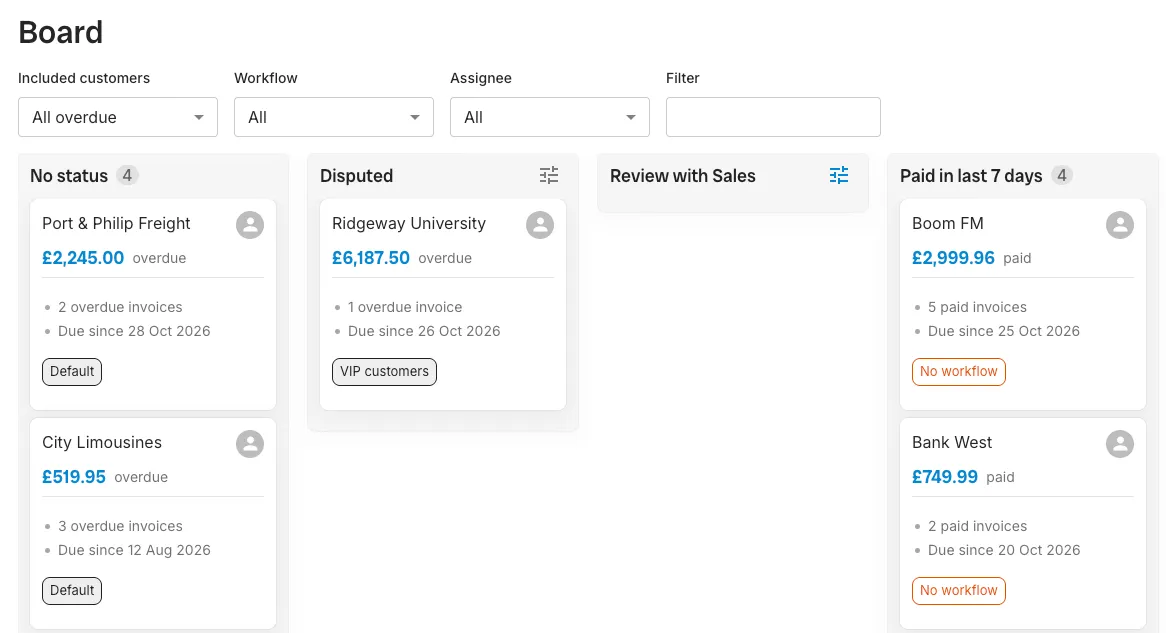
- A “Disputed” column on the board. Trove’s Kanban board shows your overdue accounts on a shared board synced with your accounting system. You set your own columns, such as “Disputed”, give each account an owner and keep notes with the account, so whoever picks it up sees what’s already been said. The board is on the Integrated plan.
- Approvals routed to the right person. With Trove’s user roles and team approvals, a reply or action can wait for a named approver, such as the customer’s account manager, before anything reaches the customer. Every approval and rejection is stored in the customer’s notes. Team approvals are on the Advanced plan.
- Replies read and drafted. Trove’s AI Reply Agent reads replies to your chasers and drafts a response for you to approve. When a customer gives a payment date for the corrected balance, it picks the date out and suggests logging it. It’s on every plan.
- The account manager sees what finance has sent. With Trove’s HubSpot integration, every chaser and statement Trove sends is logged on the customer’s HubSpot record, so the account manager can see what’s gone out before they call the buyer. HubSpot is on the Integrated and Advanced plans.
Trove doesn’t raise credit notes. Finance raises them in Xero, QuickBooks, Business Central or whichever accounting system you use, and Trove chases the balance that’s left.
FAQs about invoice disputes
Should I keep chasing the undisputed part of an invoice?
Yes. Tell the customer which amount is in question and ask them to pay the rest in their next payment run. If their system can only pay whole invoices, credit the original and reissue it as two invoices so the undisputed amount can be paid.
Who approves a credit note?
Finance approves and raises the credit note, within limits set by value, for example the credit controller up to £250, the finance manager up to £2,500 and the finance director above that. The account manager agrees the outcome with the customer first, so the credit note matches what the customer was told.
How long should an invoice dispute take?
Most pricing, paperwork and duplicate disputes can be settled within a week if they have an owner from day one. Quality disputes take longer because someone has to inspect the goods. Set a target for each type and review anything that goes past it.
What’s the difference between an invoice query and a dispute?
A query asks for information, such as a PO number or proof of delivery, and doesn’t change what’s owed. A dispute says some or all of the invoice won’t be paid until something is fixed. Answer queries the same day and keep chasing as normal.
Can Trove track disputed invoices?
Yes. You can move a disputed account into its own column on Trove’s board, give it an owner and keep the notes with it, and route replies to the account manager for approval. Read more about how Trove’s team approvals work.
Trove runs a free 30-day trial. You can start a free trial here or book a demo if you’d like to see disputes, owners and approvals on your own customers first.