

Summary
- Once more than one person touches credit control, give every customer one owner and split the work into five jobs: run the reminder sequence, answer replies, resolve queries, approve exceptions and report up.
- Finance owns the ledger and the process. The credit controller runs the sequence and answers routine replies, and the credit manager or finance lead approves credit notes, stops, write-offs and payment plans above a limit.
- The account manager owns the relationship. They answer the buyer on anything about the work or the price, approve chasers to named key accounts and have a say before a customer is put on stop. They don’t run the day-to-day chasing.
- Each role needs a short list of decisions it can take alone, so the credit controller never waits for permission on a routine reminder and the account manager only hears about the accounts that need them.
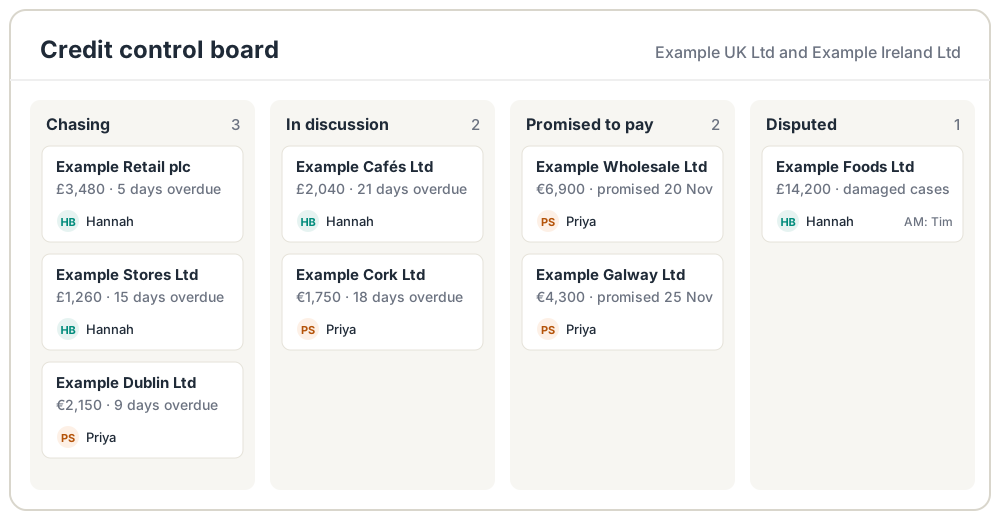
- Trove is credit control software that puts these roles into the tool: an owner on every customer on the Kanban board, entity access and approvals with user roles and permissions, and AI-drafted replies that the owner approves.
The five jobs in credit control, and who does each
Credit control is five jobs, and most of the friction in a team comes from two people thinking the same job is theirs, or neither thinking it is. Write down who does each one and which decisions they can take without asking.
| Job | Typical owner | Decisions they take alone | When they hand over |
|---|---|---|---|
| Run the sequence | Credit controller | Sending reminders and statements on schedule, pausing a reminder for a few days while a query is checked, updating contacts, logging a promised date | When a reminder is due to a named key account, or the customer hasn't replied after three chasers |
| Answer replies | Credit controller | Replying to promises to pay, remittances, requests for a copy invoice and "who should I send this to?" emails | When the reply is about the work, the price or the terms, or the customer says they can't pay |
| Resolve queries | Account manager for commercial queries, credit controller for admin ones | Account manager: agreeing with the buyer what was delivered and what's owed. Credit controller: fixing a missing PO, a wrong address or a lost invoice | When the fix needs a credit note, a revised invoice or a payment plan, it goes to the finance lead |
| Approve exceptions | Credit manager or finance lead | Credit notes, write-offs, payment plans and stops, up to their agreed limit | Above their limit, or on a key account, they agree it with the account manager or the FD first |
| Report up | Credit manager or finance lead | What goes in the weekly overdue report and the monthly debtors pack | When a balance needs a decision from the FD or the board, such as recovery action |
Sales has no row of its own for chasing. The account manager’s part sits inside “resolve queries” and in the approvals on their key accounts, which is where their relationship actually changes the outcome.
Credit controller: runs the sequence and owns the ledger
The credit controller keeps the ledger accurate and makes sure every overdue invoice is being chased by someone. Day to day, that means checking replies first thing, logging any promised dates, sending the reminders and statements that are due, and moving accounts along the board as things change.
The point of the role is that it doesn’t wait. A credit controller shouldn’t need permission to send a routine reminder, ask for a remittance, correct a contact or pause a reminder for a couple of days while they check a query. If every reminder needs a sign-off, the sequence slips and the customers who pay on the third chaser start paying on the sixth.
What they do hand over is anything that changes the amount owed or the relationship: a credit note, a dispute about the work, a customer who says they can’t pay, or a key account that’s about to get a firmer reminder.
Credit manager or finance lead: approves exceptions and reports up
The credit manager or finance lead decides the things the credit controller can’t. In a team of 2 to 4 people, this is usually the financial controller or finance manager, not a separate credit manager.
Give them clear limits, so the exceptions don’t all end up with the FD:
- Credit notes up to an agreed value, once the account manager has confirmed what’s owed.
- Payment plans up to an agreed length or value. Here’s when to offer a payment plan if you need a starting point.
- Putting a customer on stop, after the account manager has had a chance to call.
- Write-offs and the decision to start formal recovery.
The other half of the role is reporting. The finance lead owns the weekly overdue report and the monthly debtors meeting pack, and decides what goes up to the FD.
The difference between a credit controller and a credit manager, then, is mostly about authority. The credit controller runs the process. The credit manager decides the exceptions and answers for the numbers.
Account manager or sales: owns the relationship
The account manager is the person the customer actually listens to, so they handle the conversations where that matters. They answer the buyer on anything about the work, the price or the terms. They approve the firmer chasers to named key accounts. And they get a call before one of their customers goes on stop.
At Example UK Ltd, before the second reminder goes to Example Foods Ltd, a key account, it waits for Tim, the account manager, to approve it. If Example Foods’ buyer replies that a delivery was short, Tim answers that too, because he’s the one who can agree what was delivered.
Finance still runs the sequence and owns the ledger: Hannah, the credit controller, logs the outcome and the next reminder goes out on schedule. Tim is there for the two moments where the relationship changes what happens. The chasing in between stays with finance.
What the account manager shouldn’t do is chase routinely. If you want to know when to bring them in on a specific overdue account, here’s when to hand an overdue account to the account manager, with triggers you can agree with sales.
The teams we spoke to who wanted sales kept informed chose a scheduled report per rep instead of copying reps on every chaser. The report lists that rep’s customers over 30 days overdue and goes out once a week. Reps see their own overdue accounts in one email, and their inbox isn’t full of reminders they don’t need to act on.
Splitting a ledger across two or more controllers
Split the ledger so that every customer has exactly one owner. That’s what stops two people chasing the same customer in the same week, or both assuming the other one has it.
There are three common ways to split it:
| Split | Works best when | Watch out for |
|---|---|---|
| By entity | You run several companies, each with its own accounting file and customers | A customer who buys from two of your companies. Agree which entity's controller leads |
| By customer size | A few large accounts make up most of the balance | The large-account owner ends up with all the disputes. Balance the workload, not the customer count |
| Alphabetically or by region | Many similar-sized customers on one entity | New customers need an owner the day they're added, or they slip through |
Whichever split you pick, put the owner where everyone can see it, not in someone’s head. If you’re splitting by entity across a group, here’s how in-house teams run credit control across several companies.
Who answers a customer’s reply
Route each reply by what the customer is saying, not by whose inbox it landed in. Most replies are routine, and the credit controller should answer them the same day without asking anyone.
| Reply type | Example | Who answers | What happens next |
|---|---|---|---|
| Promise to pay | "We'll pay on the 28th" | Credit controller | Logs the date, pauses reminders until then and follows up the day after if nothing arrives |
| Admin query | "We need a PO number" or "Please resend the invoice" | Credit controller | Fixes it with accounts payable and keeps the sequence running |
| Dispute about the work or price | "Two cases were damaged" or "That's not the price we agreed" | Account manager | Agrees the outcome with the buyer. Finance raises any credit note and the disputed invoice is paused, not chased |
| Wrong contact | "I've left, try Rob in accounts" | Credit controller | Updates the contact and resends to the right person |
| Hardship | "We can't pay this month" | Finance lead, with the account manager told | Agrees a payment plan within their limit, or decides on a stop |
| Invoice on hold | "Your invoice is on hold pending approval" | Credit controller | Asks what's needed to release it and who's approving it |
The “on hold” reply catches a lot of teams out, because it looks like a dispute and usually isn’t. Here’s how to answer an “invoice on hold” reply. For disputes, pausing reminders for one customer keeps the rest of the sequence running while it’s sorted.
A worked example: Example UK Ltd with three people and six sales reps
Example UK Ltd sells to retailers and wholesalers in the UK and Ireland through two companies, Example UK Ltd and Example Ireland Ltd. Credit control is three people: Hannah and Priya, both credit controllers, and Sam, the finance manager. There are six account managers, including Tim, who looks after Example Foods Ltd and four other key accounts.
They split the ledger by entity. Hannah owns every Example UK Ltd customer, Priya owns every Example Ireland Ltd customer, and Sam sees both. Here’s how November went.
| When | What happened | Who |
|---|---|---|
| Every Monday | Each account manager gets a scheduled report of their own customers over 30 days overdue | Sent automatically, set up by Sam |
| Mon 2 Nov | Reminders and statements go out on both entities. Each customer hears from one controller only | Hannah (UK), Priya (Ireland) |
| Wed 4 Nov | Example Wholesale Ltd replies with a payment date of 20 Nov. Priya logs it and its reminders pause | Priya |
| Mon 9 Nov | The second reminder for Example Foods Ltd's £14,200 invoice is due. As a key account, it waits for Tim's approval. He approves it the same morning and it sends | Tim approves, Hannah's sequence sends |
| Tue 10 Nov | Example Foods' buyer replies that six cases arrived damaged. Hannah pauses chasing on that invoice and passes it to Tim | Hannah |
| Thu 12 Nov | Tim agrees with the buyer that £540 is due back. Sam approves the credit note, Hannah raises it and the balance of £13,660 goes back into the sequence | Tim, Sam, Hannah |
| Mon 16 Nov | An Irish customer replies that they can't pay this month. Priya passes it to Sam, who agrees a three-month payment plan and tells the account manager | Priya, Sam |
| Mon 30 Nov | Sam sends the monthly debtors pack to the FD, with the Example Foods credit note and the new payment plan noted | Sam |
Tim stepped in twice all month: one approval on 9 November and one call with the buyer about the damaged cases. Hannah and Priya never chased the same customer, and nothing that changed the amount owed went out without Sam seeing it.
How Trove sets up the roles
Trove turns the table above into settings, so the roles hold when the team is busy or someone is off.
- An owner on every customer. On the Kanban board (Integrated plan), each account has an owner and sits in a column such as in discussion, disputed or promised to pay. Notes stay with the account, so whoever picks it up next sees what’s been said.
- Entity access for a split ledger. With user roles and permissions (Advanced plan), each credit controller only sees and chases the entities they look after, and the finance lead sees the whole group. Multi-entity support keeps each company chasing from its own address.
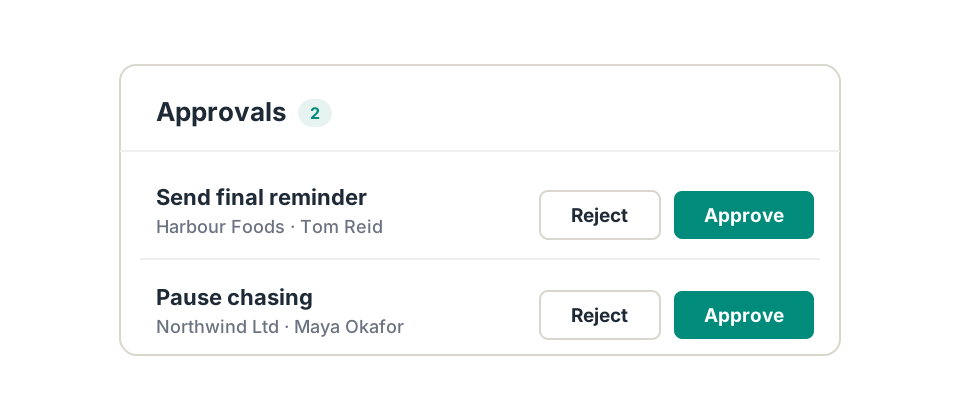
- Approvals before anything sensitive goes out. Also on Advanced, you can limit who sends emails and other actions. Anything else goes to an approver’s task list, and every approval and rejection is stored in the customer’s notes. Each customer can have an account manager set, and you can route an approval to a specific person, so the second reminder to a key account waits for that customer’s account manager.
- Replies drafted for the owner to approve. The AI Reply Agent (every plan) reads replies to your chasers, picks out promised dates and drafts the response. The owner approves or edits it before it sends.
- Reports for sales, without a login. Credit control reports can go out daily, weekly or monthly by email, with no Xero or Trove login needed. On Integrated you can build a report filtered on owner and days overdue, and send one to each rep.
- Visibility in HubSpot. With the HubSpot integration (Integrated plan), every chaser and statement Trove sends is logged on the customer’s HubSpot record as email activity, so account managers see it where they already work.
Trove has unlimited users on every plan, so account managers can log in to see their customers’ history without anyone buying another seat. Trove’s plans are Essential at £65, Integrated at £140 and Advanced at £300 a month. If you’re on Business Central and HubSpot, here’s how to show account managers which customers are overdue.
FAQs
What are the roles and responsibilities in a credit control team?
A credit controller runs the reminder sequence, answers routine replies and keeps the ledger up to date. A credit manager or finance lead approves exceptions such as credit notes, stops and payment plans, and reports to the FD. The account manager owns the relationship and steps in on commercial queries and key accounts.
Who should answer replies to invoice reminders?
The credit controller should answer routine replies, such as promises to pay, remittances and requests for a copy invoice. Replies about the work, the price or the terms go to the account manager, and hardship goes to the finance lead. Read more about how Trove’s AI Reply Agent drafts replies for the owner to approve.
Does sales chase overdue invoices?
Not as a routine. Finance runs the chasing, and the account manager steps in at agreed points: approving chasers to key accounts, settling disputes and calling a customer before they’re put on stop. A weekly report of their own overdue customers keeps them informed without copying them on every chaser.
What’s the difference between a credit controller and a credit manager?
The credit controller runs the day-to-day chasing and keeps the ledger accurate. The credit manager decides the exceptions, such as credit notes, payment plans, stops and write-offs, and reports on the debtor book. In smaller teams the finance manager often does the credit manager’s job.
How many credit controllers do I need?
It depends less on the number of invoices than on how many accounts need a decision each week. Once the sequence runs automatically, one credit controller can cover a much larger ledger, and a second is usually needed when you add an entity or a group of large accounts with regular disputes. If nobody does it full time yet, here’s how teams run credit control without a dedicated AR person.
Trove runs a free 30-day trial and takes about 15 minutes to connect to your accounting system. You can start a free trial here or book a demo if you’d like to see owners and approvals set up for your team first.