

Summary
- Trove is credit control software that automates chasing from your accounting system. Its product data shows how finance teams bring sales into that process.
- 64% of Trove customers involve sales in their credit control system. That’s a minimum, because Trove can’t see a conversation in the office or a phone call.
- Keeping sales informed is more popular than assigning them tasks. 43% of organisations send sales a regular report or an ad-hoc email while 21% give sales access to Trove or send chasers in their name.
- Finance should still run the process. Sales owns the customer relationship, so bring them in where it gets sensitive, which mostly means escalations.
- The right method depends on two things: how well your chasing already works, and how sensitive your customer relationships are.
- Trove can send sales a scheduled report in Slack or Teams, or send later chasers from the account manager on the Integrated plan.
64% of businesses involve sales in their credit control system
“Sales” here is used as shorthand for sales, account management or customer success.
Across Trove, 64% of organisations involve sales somewhere in their credit control system. The other 36% handle it offline or don’t involve sales at all.
That 64% is the minimum. Trove does not track conversations in the office or by the water cooler. Some of the 36% will involve sales informally outside of their Trove system. So the real share of businesses that involve sales is at least 64%, and probably higher.
Keeping sales informed vs giving them a hands-on role
43% of organisations keep sales informed, with a regular report or an ad-hoc email. 21% give sales a hands-on role, either with access to Trove or with chasers sent from a salesperson. Keeping sales informed is about twice as common as giving them a hands-on role.
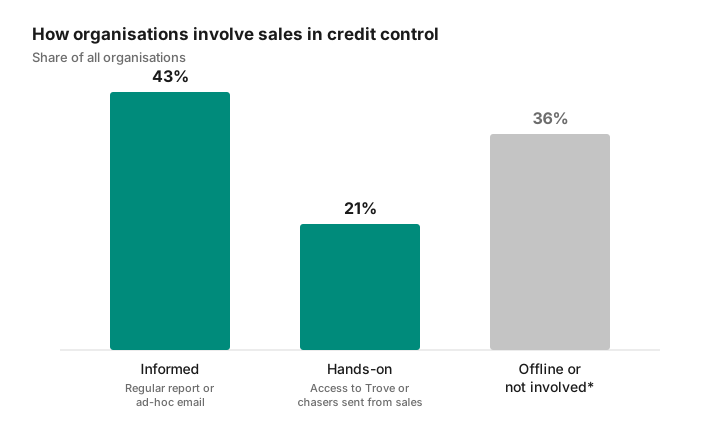
Most finance teams want sales to know what’s going on, without handing them the job.
Four ways to involve sales in credit control and when to use each one
The most common single method is a regular report. Ad-hoc emails come next, then access to Trove, then chasers sent from sales.
Send sales a regular overdue invoices report
Sales gets a list of overdue invoices on a schedule, for example every Monday morning. It fits when credit control already works well and sales just needs an FYI, so nobody is surprised on a call with a customer. The trade-off: a report tells sales what’s late, but doesn’t ask them to do anything about it. Trove’s credit control reports can be scheduled for this.
Email sales about specific overdue invoices when needed
Finance emails the account manager about a specific customer when something needs their attention. It fits when only a few invoices slip through the gaps. The trade-off: it relies on someone in finance remembering, and gets harder to keep up as the ledger grows. An automatic alert, such as getting alerted when a customer first goes overdue, takes the remembering out of it.
Give sales access to your credit control software
Sales logs in and checks accounts themselves: what’s overdue, what’s been sent and what the customer said. It fits when sales wants to be more hands-on, for example before a renewal or a new order. Trove has unlimited team members on every plan, so this doesn’t add cost. The trade-off: access only helps if sales actually looks, and everyone needs to know who does what in credit control so a customer isn’t chased by two people at once.
Send payment reminders from the account manager
Some steps in the chasing sequence go out in the account manager’s name. It works as an escalation route for trickier customers who are slower to pay. Finance still runs the schedule, and the email just comes from someone the customer knows. The trade-off: the account manager needs to be ready for replies to land in their inbox.
Some organisations combine methods. For example, every chaser goes out from sales, and sales also gets a regular report. Or finance sends the early reminders and the final escalation comes from the account manager, with a weekly report on top.
How often does sales send reminder emails as part of credit control
Among businesses that send chasers from sales, the share varies a lot. Some send only the final escalation from sales, which is about 6% of their invoices. Businesses with bigger account management teams send up to 100% of their chasers from their account managers.
Sending chasers straight from account managers or sales is mostly something bigger businesses do, generally those over £10m turnover. They tend to have dedicated account managers for each customer, so a chaser in that person’s name reads as normal account contact.
Sales owns the relationship, not the mechanics of when to send a payment reminder
Sales owns the relationship with the customer. That’s why they should be involved when chasing gets sensitive, and that mostly means escalations. Trove’s data shows most paid invoices are paid after one or two reminders, so most accounts never need sales at all. The ones that do are usually accounts that have stopped replying, large balances going well past due, or disputes about the work.
If you have a few very large customers, every touchpoint can be sensitive. Then it can make sense to send every email in the account manager’s name, while finance still runs the process and keeps the ledger.
Whatever your set-up, give sales a defined part. That could be a weekly report, an escalation step in the sequence, or access to Trove. A defined part means sales knows what’s expected of them, and finance doesn’t have to decide case by case whether to interrupt them. For when to hand an account over, and when not to, here’s when to hand an overdue account to the account manager.
How to set up sales involvement in Trove
Both set-ups below are on Trove’s Integrated plan.
Send sales a regular report
- Connect Slack or Microsoft Teams to Trove.
- Choose the report you want sales to get and how often, for example a weekly overdue invoices report.
- Pick where it goes: a shared channel or a direct message to each account manager.
- Each alert and report links to the customer in Trove, so sales can click through to the history.
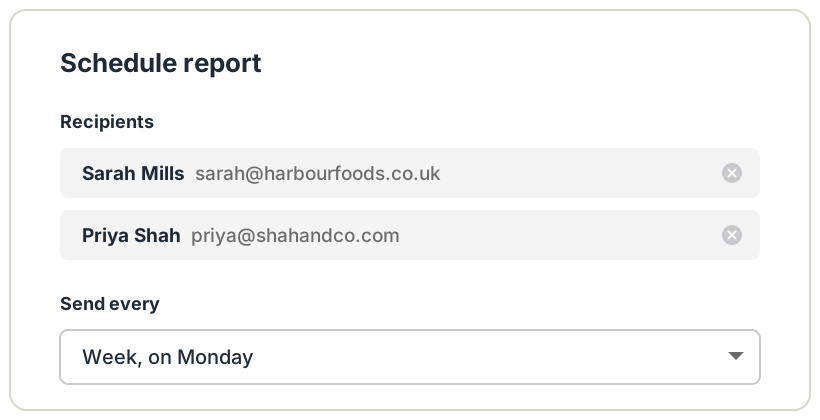
More on Slack and Teams alerts in Trove.
Send a payment reminder from an account manager
- Connect HubSpot to Trove, so Trove knows who owns each customer.
- Open the workflow for the customers you want to escalate.
- On the step you want, for example the final escalation, set the sender to the HubSpot owner.
- Trove sends that step in the account manager’s name. Finance still controls the schedule and the earlier steps.
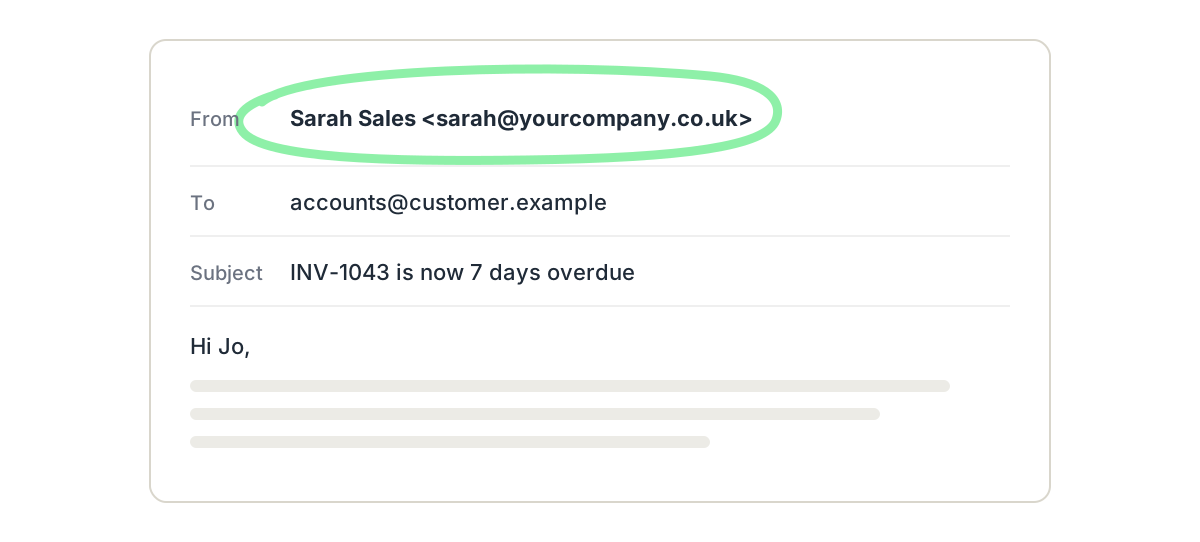
You can also copy the owner in at a set point, or hand the account over to them. More on Trove’s HubSpot integration. If your ledger is in Business Central, here’s how to show account managers which customers are overdue in HubSpot.
The mistake to avoid: copying sales in on every chasing email
Copying sales in on every single chaser floods their inbox, and they soon stop reading. When an account really needs them, the email gets lost with the rest.
A report or a chaser sent from sales gives them a clear job instead. If you do copy the owner in, do it on the steps where their input matters, such as the final reminder.
Methodology behind the data report
Source: Trove product data, aggregated and anonymised.
Period: June to November 2026.
Limit: activity outside Trove, such as calls, Slack or the CRM, isn’t visible. The offline group may include businesses that do involve sales.
Definition: “sales” covers sales, account management and customer success.
FAQs
Should sales chase unpaid invoices?
No. Finance should run the chasing and keep the ledger. Sales steps in on escalations, or for key accounts the chasers can go out in the account manager’s name while finance still runs the schedule.
Should I copy my sales team into payment reminders?
Not on every reminder, or they’ll stop reading them. Copy the account manager in on the steps where their input matters, such as a final reminder, and keep them informed with a regular report.
How do I keep sales informed about overdue invoices?
Send them a regular report of overdue invoices, for example weekly. Trove can post scheduled reports to Slack or Teams, in a shared channel or as a direct message, with links to each customer.
When should an account manager send a payment reminder?
When an account needs escalating, for example after several unanswered chasers or a missed payment date. For businesses with a few very large customers, every reminder can go out in the account manager’s name.
How many businesses involve sales in credit control?
At least 64% of Trove customers involve sales in their credit control system. 43% keep sales informed with a report or email, and 21% give sales a hands-on role.
Trove runs a free 30-day trial and takes about 15 minutes to connect to your accounting system. You can start a free trial here or book a demo if you’d like to see it first.